
How to Run Your First TTRPG Session as a New Game Master
You said yes to running a game. Maybe your regular game master moved away, maybe your friends looked at you across the table and said "you should run one," or maybe a shiny rulebook has been sitting on your shelf begging to be used. Now the first session is on the calendar and a small voice is asking a reasonable question: what if you freeze up and it all falls flat?
Here is the good news. Running your first TTRPG session as a new game master is far more forgiving than it looks. You do not need to memorize a rulebook or write a novel. You need a simple plan, a few honest conversations, and a willingness to say "let me make a ruling and we will check the book later." The rest is just people telling a story together, and you are the one holding the map.
Start smaller than you think
The most common mistake new GMs make is scope. It is tempting to open with a sprawling ten year campaign about warring kingdoms and ancient prophecies. Resist that. Your first outing should be a one-shot, a self-contained adventure that starts and finishes in a single sitting. Most one-shots run two to four hours and have a clear, solvable goal: rescue the merchant, clear the haunted mill, find out who poisoned the well.
A one-shot does three useful things for you. It lets you practice the core loop of describing a scene, asking "what do you do," and resolving the answer, without committing to months of story. It gives your table a low pressure way to test their chemistry. And if it goes well, a one-shot can quietly grow into a campaign later, because the characters and the world are already on the table.
Hold a session zero before you roll anything
A session zero is a short meeting, sometimes its own night and sometimes just the first half hour of play, where the group agrees on how the game will work before the dice come out. This is the single highest value habit a new GM can build.
Cover the practical stuff first: which system you are using, the tone (goofy heist, grim horror, cozy village mystery), how often you will meet, and how the characters connect. A quick prompt like "how does your character already know one other person here" saves you an awkward opening hour of strangers refusing to cooperate.
Then talk about comfort. Safety tools sound formal, but they are simple. Lines and veils let the group name topics that will not appear at all (lines) and topics that can exist in the world but stay off screen (veils). An X-card is just a card anyone at the table can tap to say "let us move past this," no explanation required. Naming these things once, calmly, means nobody has to be brave about it in the moment later.
Your first session does not need to be impressive. It needs to be finished, fair, and fun. Those three are enough, and they are plenty.
Prep the spine, improvise the muscle
New GMs tend to over-prepare the wrong things. You cannot script what players will do, so do not try. Prep the spine of the adventure and let the muscle grow at the table.
A workable spine fits on a single page: a strong opening scene, three to five interesting locations or encounters, a couple of memorable characters with a clear want, and a rough idea of what happens if the players do nothing. Jot down names, a few numbers, and any clues. Skip the long boxed monologue you will never actually read aloud.
Keep a cheat sheet of the six or seven rules you will really use (how a check works, how initiative runs, how damage lands) within arm's reach. When a rules question stops play, make a quick ruling in the players' favor, write it on a sticky note, and look it up after the session. Momentum matters more than being right in the moment.
Your first hour at the table
Give the night a soft start. Budget the first fifteen or twenty minutes for snacks, catching up, and sorting dice, because you will not have anyone's full attention until then anyway. Then open with a scene, not a lecture. Drop the characters into something already in motion: a scream from the alley, a job offer they cannot refuse, a body lying in the road.
From there the loop is simple. Describe what the characters sense, ask what they do, and call for a roll only when the outcome is both uncertain and interesting. Spotlight every player early so nobody sits quiet for an hour. When in doubt, cut to the fun. If searching an empty room is boring, tell them what they find and keep things moving.
Expect the session to wobble. You will forget a rule, fumble a funny voice, and mispace a scene or two. Every veteran GM you admire has a pile of clumsy early games behind them. That is not failure, that is the tuition you pay to get good.
Tools that make the first session easier
A solid published adventure or GM guide removes a huge amount of blank page anxiety, which is why leaning on one for your debut is smart rather than lazy. If the system you are running has an official runner's guide, read its first chapter and borrow the structure.
One example on DevLoot's tabletop shelf is Faith: The Shepherd's Companion ($4.99), the game master guide for Faith, a Christian tabletop RPG by Rutz Studios. Faith is built for players and groups who want their table to reflect their beliefs, and the Companion is aimed squarely at the person behind the screen. It walks a new GM (a "Shepherd," in its language) through running campaigns, building Trials for the party, and handling the game's signature Faith Die, the resource at the heart of its core mechanic. If that theme fits your group, it is a friendly on-ramp to the GM chair. If it is not your table's style, the running advice inside still translates, and the broader point holds: pick a guide that matches the game you actually want to run.
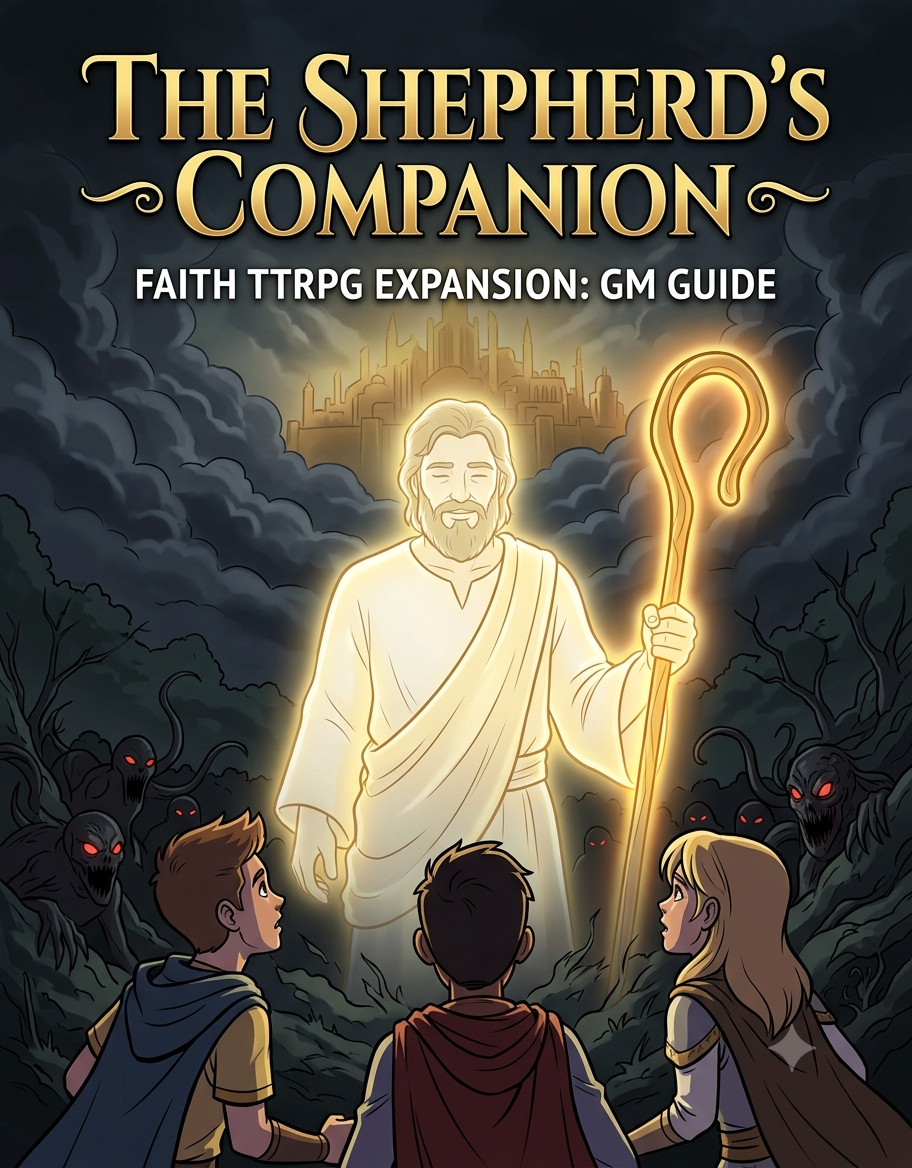
Cover art for Faith: The Shepherd's Companion by Rutz Studios.
To run Faith in full it pairs with the Faith Core Rulebook ($19.99) and the two page Faith Character Sheet ($1.00). For a wider look at how belief and tabletop play meet, our earlier piece on faith-based tabletop RPGs covers the niche and who it is for, whatever your own background.
One clear next step
Do not wait until you feel ready, because that day never quite arrives. Pick a short adventure, book a two hour slot, send your players a one line pitch, and run it. Bring the spine on a single page, keep your rulings quick, and let the table surprise you. When it is over, ask everyone for one thing they loved and one thing they would change, then run it again a little better.
That is the whole secret. Not talent, not a flawless script, just reps. Your tenth session will look nothing like your first, and the only way to reach it is to run the first one. For more reading while you plan, browse the rest of the DevLoot blog.
Hero photo: polyhedral game dice via Wikimedia Commons.
