
PDF vs Print RPG Books: Which Format Should You Buy?
You found a game you want to play. The store gives you two buttons: PDF for a few dollars, or a hardcover for thirty to sixty. Maybe there is a third button that bundles both. Which one do you press?
This question sounds trivial and it really is not. The format you buy changes how you prep, how fast you find a rule mid-session, whether your whole table can reference the book, and whether you still own the thing in ten years. I have bought both badly and both well. Here is how to decide without wasting money.
What a PDF is actually good at
Search. That is the headline and it deserves to be. Hitting Ctrl+F for "grapple" and landing on the right paragraph in two seconds is a different experience than flipping through an index that may or may not list the term you remembered. If you are the GM and four players are staring at you, two seconds versus ninety seconds matters.
PDFs also travel free. Your entire library fits on a tablet you already own. You can run a game from a hotel room, a lunch break, or a friend's kitchen table without hauling a backpack of hardcovers. For anyone who plays online through a virtual tabletop, the PDF is simply the native format. You are already looking at a screen.
Price is the other honest advantage. Digital editions typically run a fraction of print, because there is no printing, no warehousing, and no shipping. That gap is why PDFs are how most people try an unfamiliar system. Spending five dollars to find out a game is not for you stings a lot less than spending fifty.
One thing worth knowing before you buy: most tabletop RPG PDFs sold today are DRM-free. Storefronts like DriveThruRPG moved away from DRM back in 2005 and now apply a light per-purchase watermark instead, which means the file opens on any device you own and keeps working if the store disappears. Not every seller is DRM-free, so it is worth a glance at the product page.
A PDF is a tool you use during play. A hardcover is a thing you read in a chair. Most tables need both, but they need them at different moments.
What print still does better
Spatial memory is real and it is underrated. After a few months with a physical book you stop looking things up and start reaching. You know the initiative rules are on a left-hand page about a third of the way in, near the illustration with the archer. No search box gives you that. Cognitive research on reading has been circling this for years, and anyone who has run a long campaign from a hardcover recognizes it immediately.
Print is also the only format that works as a shared object. A book can sit open in the middle of the table. Three people can lean over it. A player can borrow it during their turn while you keep narrating. Tablets are single-user devices by design, and passing one around feels wrong in a way passing a book does not.
Then there is the part nobody wants to admit out loud: books are nice. A well-made rulebook with good art and a sewn binding is a pleasant object, and pleasant objects get pulled off the shelf more often. If owning the physical copy makes you more likely to actually run the game, that is a legitimate reason to buy it.
The costs are equally real. Print is heavy, expensive, and slow to search. Errata that gets fixed in the PDF next month stays wrong in your hardcover forever. And if the publisher revises the game, your shelf ages while the digital file updates.

A GM's side of the table, books and notes and all. Photo via Wikimedia Commons.
.jpg)
The rule I actually use
Buy the PDF first. Always. Read it, run one session, and see whether the game survives contact with your table. Most games do not, and that is fine. If it sticks, buy print for the one or two systems you will run for a year or more.
Two useful shortcuts on top of that. First, look for bundles: many publishers discount print heavily if you already own the PDF, or include a digital code with the physical book. Second, check for print-on-demand. Storefronts have expanded POD substantially, which means smaller games that would never justify an offset print run are still available as a real book, printed when you order it. Softcover POD often lands well under a traditional hardcover.
There is one case where I skip print entirely: games I only run online. If every session happens on a VTT, a physical book adds nothing but shelf space.
Where character sheets change the math
Sheets are the one place where the formats invert. A form-fillable PDF sheet that auto-fills nothing is still better than a scanned image, and a printable sheet you can run off ten copies of is better than either for an in-person table. Look for products that ship both a print-friendly version (no heavy background art, black text, no ink-devouring page borders) and a fillable one. If a game only gives you one, that tells you something about how much thought went into the rest of it. We went deeper on this in what makes a good TTRPG character sheet.
A digital-first example worth looking at
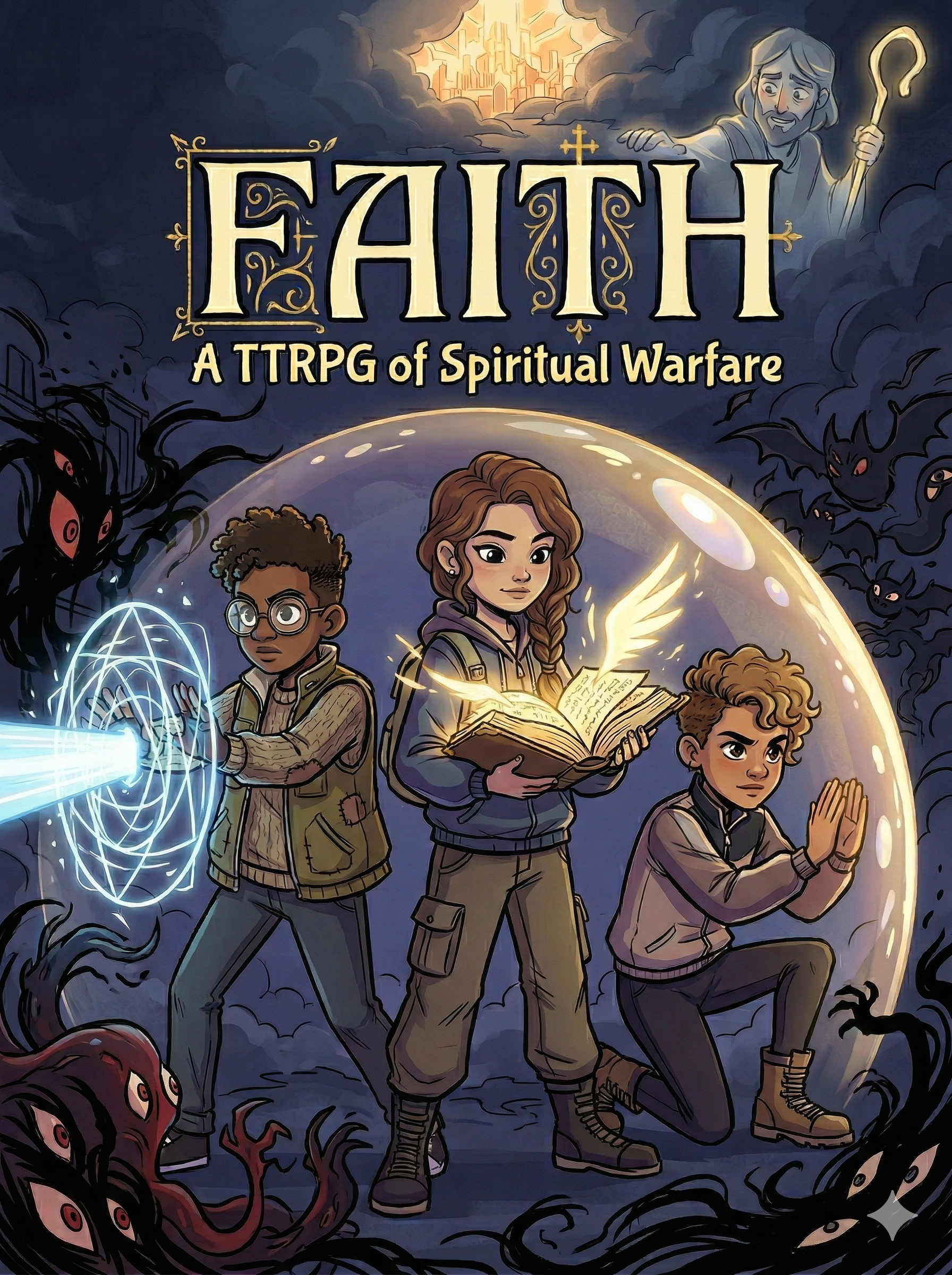
The Faith Core Rulebook by Rutz Studios, sold on DevLoot.
Faith is a Christian tabletop RPG from Rutz Studios, built around a Faith Die mechanic where characters act on conviction rather than certainty. It is a niche game with a clear audience: groups who want a system whose themes come out of a Christian framework, the way other games build their mechanics around cosmic horror or courtly intrigue. If that is not your table's thing, no hard feelings. If it is, it is worth a look, and the same buying logic applies.
What makes it a useful example here is that the line is structured the way a digital-first product should be. The Core Rulebook runs $19.99. The two-page character sheet is sold separately for $1.00 so you can grab it before committing, and The Shepherd's Companion, the GM guide covering campaign structure, Trials, and worldbuilding, is $4.99. You can start at a dollar, decide whether the mechanics appeal, and scale up. That is the PDF-first path working exactly as intended. If you want more context on this corner of the hobby, we covered it in our guide to faith-based tabletop RPGs.
The short version
- Trying a new system? PDF. Every time.
- Running online only? PDF, and stop there.
- Running the same game for a year in person? Buy print, and keep the PDF for mid-session lookups.
- Character sheets? Get the printable version even if you play digital. You will want it.
- Before you buy print: check for a bundle discount or a print-on-demand softcover.
The format wars are mostly imaginary. PDF and print solve different problems, and the cheap move is to let the PDF prove the game is worth the shelf space. Start there, run a session, and let the table decide.
Browse the TTRPG shelf on DevLoot if you want somewhere to start.