
Session Zero and Safety Tools: How to Start a TTRPG Campaign That Lasts
Most TTRPG campaigns do not die in a blaze of dragon fire. They die in month two, when one player wanted gritty survival horror, another wanted a heist comedy, and the GM was quietly building a political epic nobody asked for. The group never fought about it. They just started missing sessions.
A session zero fixes most of that before it starts. It is one meeting, held before play begins, where the group agrees on what game it is actually playing. Add a couple of lightweight safety tools and you have covered the two biggest campaign killers: mismatched expectations and unspoken discomfort. Here is how to run one that takes about an hour and does not feel like a corporate training video.
What a session zero actually is
A session zero is a scheduled conversation, not a play session. Plenty of groups roll it into character creation night, which works well because people have something to do with their hands. The agenda is simple: pitch the game, set the tone, build characters together, and settle table logistics. That is it.
Groups that skip it usually end up having the same conversation anyway, except it happens in week six, mid argument, with feelings already bruised. An hour up front is cheaper. If you are about to run your very first game, session zero pairs naturally with our guide on running your first TTRPG session as a new GM.
Pitch the tone like a movie trailer
Start with the GM's pitch: premise, genre, and, crucially, a rating. Saying "this is a PG-13 game" out loud does more work than an hour of vague discussion. So does naming touchstones. "Think early seasons of Critical Role" and "think The Terror, but fantasy" describe two completely different Tuesdays.
Then ask each player one question: what do you want more of at the table? Combat, intrigue, shopping episodes, romance, dungeon puzzles. You are not promising everything to everyone. You are finding out whether the group even overlaps before you spend forty hours together finding out the hard way.
Safety tools, explained without the awkwardness
Safety tools have a reputation problem. Some players hear the phrase and picture a permission slip for a bake sale. In practice they are the opposite of restrictive, and most of them take two minutes to set up.
Safety tools are not about limiting the story. They let the table go to darker, stranger, more personal places, because everyone knows there is a way back.
Lines and veils
The classic, popularized by designer Ron Edwards. A line is content that will not appear in the game at all. A veil is content that can exist in the fiction but happens offscreen, with a fade to black. During session zero, go around the table and collect both. Common examples: harm to children as a line, torture as a veil. Write them down, keep the list where the GM can see it, and revisit when the campaign shifts gears.
The X-Card
Created by John Stavropoulos. Put an index card with an X on the table. Anyone can tap it at any time, and whatever is happening in the fiction gets edited out, no explanation required. That last part matters: nobody owes the table a justification. It shines at conventions and one-shots where strangers have no baseline trust yet.
Script Change
Beau Jagr Sheldon's toolkit borrows film language: rewind a scene that landed wrong, pause to check in, fast forward past content nobody needs to sit through. It is more granular than the X-Card and suits long campaigns where you want options between "fine" and "stop."
Stars and wishes
Technically a feedback ritual rather than a safety tool, and it came out of The Gauntlet's play community. At the end of each session, every player names a star (something they loved) and a wish (something they want next time). Five minutes, and it quietly prevents the resentment buildup that kills campaigns slower but just as dead.
Pick one or two. A table running lines and veils plus stars and wishes has covered ninety percent of what goes wrong socially at game tables.
When the game touches real beliefs
Horror games are the obvious case for safety tools, but they are not the only one. Any game built around something players hold personally, grief, family, or faith, deserves the same care.
Faith-based TTRPGs are a real and growing corner of the hobby (we wrote a full history in Faith-Based Tabletop RPGs: Is That Actually a Thing?). When the material connects to beliefs people actually live by, session zero stops being optional. Who is at your table? A church small group has one set of expectations. A mixed table where one player is not religious has another. A family table with kids has a third. None of those tables is wrong, but they want different games, and ten minutes of conversation sorts it out.
This is a spot where the GM guide for Faith, the Christian tabletop RPG from Rutz Studios, earns its keep. Faith: The Shepherd's Companion is written for the person running the game (the Shepherd, in Faith's terms) and covers campaign structure, crafting Trials, and managing the Faith Die, the system's core mechanic. It is $4.99, which is impulse-buy territory for a full GM guide, and it treats the question of who your table is as a real prep step rather than an afterthought.
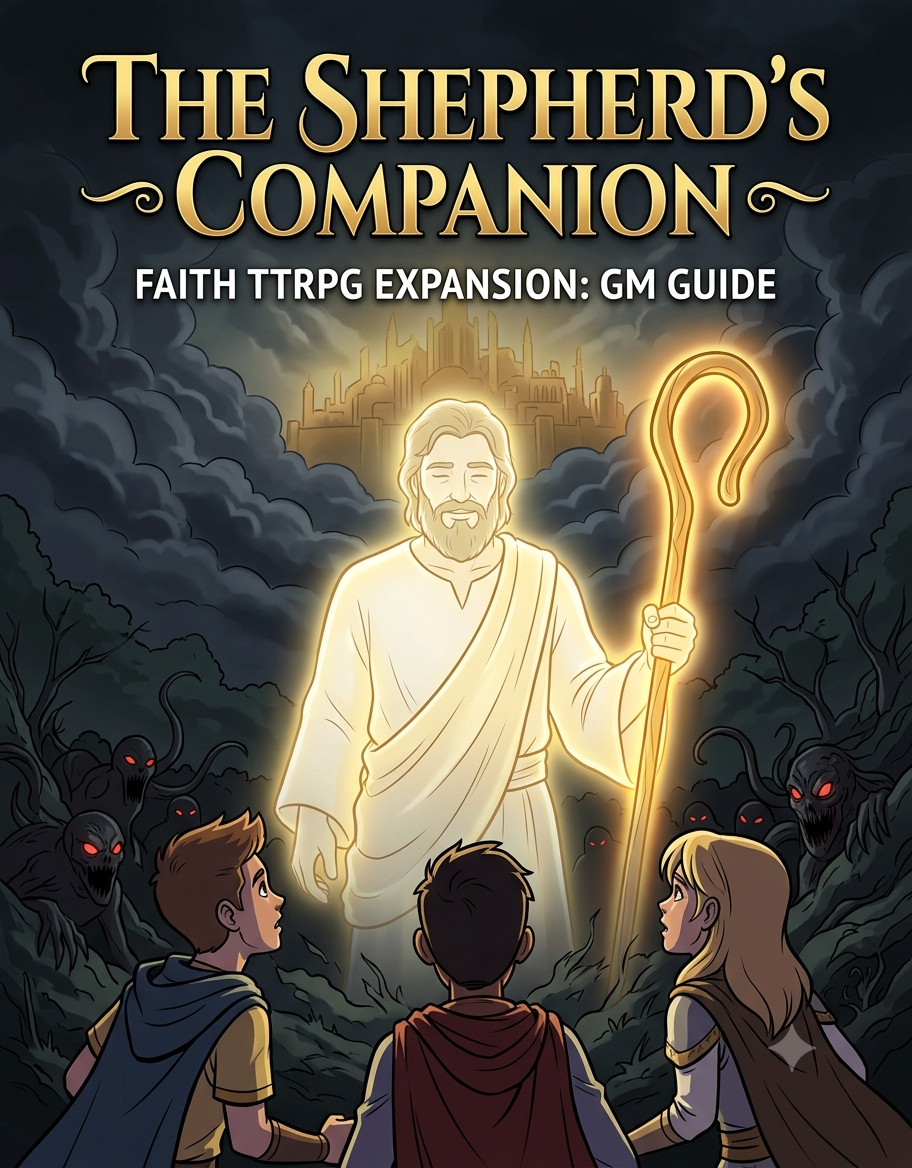
Faith: The Shepherd's Companion, the GM guide for the Faith TTRPG by Rutz Studios.
If you are starting from zero, the Faith Core Rulebook is the entry point, and there is a two-page character sheet to match. And to be clear, the session zero advice cuts both ways: if your table is not looking for faith content, that is exactly the kind of thing session zero exists to surface before anyone buys a book.
A 60-minute session zero agenda
Steal this and adjust:
- The pitch (10 min). Premise, genre, rating, touchstones. Players ask questions.
- Lines and veils (10 min). Collect them. Offer a private option (text the GM later) for anyone who does not want to say theirs aloud.
- Pick your tools (5 min). Choose one in-the-moment tool (X-Card or Script Change) and one debrief tool (stars and wishes).
- Characters, together (25 min). Build in the same room and require every character to have a connection to at least one other. Lone wolves are a session zero problem, not a session twelve problem.
- Logistics (10 min). Schedule, cadence, the absent-player rule, phones, snacks. Boring, and the number one predictor of whether the campaign survives.
Schedule the conversation
Session zero is the cheapest insurance in the hobby. One hour, zero prep beyond a pitch, and it replaces months of slow drift with a table that agreed on the game it wanted. Put it on the calendar before you write a single NPC. Your campaign's sixth month is decided in its zeroth session.
Hero photo: Role playing gamers, Wikimedia Commons.
