
Tabletop RPGs for Kids and Family: How to Run a Game Night That Actually Works
At some point, every parent who rolls dice gets the question. Sometimes it comes from the kid who has been watching you pack your bag for game night for two years. Sometimes it comes from you, staring down another family evening where everyone is on a separate screen. Can kids actually play tabletop RPGs? Yes. Enthusiastically, chaotically, wonderfully yes. But running a game for an eight year old is not the same job as running one for your Thursday group, and most of the advice floating around assumes a table full of adults with adult attention spans.
Here is what actually works, from picking a system your kids can handle to keeping the session short enough that it ends before the wheels come off.
Why kids take to TTRPGs so fast
Kids have been playing pretend with rules since forever. "You can't just say you dodged it" is a rules argument, and every playground has hosted a thousand of them. A tabletop RPG just hands them a fair referee: the dice. Along the way they practice reading, mental math, taking turns, negotiating with other players, and holding a story in their head across an hour of play. Teachers and librarians have noticed, which is why school D&D clubs have quietly multiplied over the past decade.
The trick is that kids do not need less story than adults. They need a different shape of story.
Kids do not need a simpler story. They need a shorter one with a real ending.
Pick a system that matches their age
You can absolutely run D&D for a ten year old. You should probably not run it, as written, for a five year old. A few honest recommendations by age band:
Ages 4 to 7: pictures beat numbers
Hero Kids is the classic entry point here. Character sheets use pictures instead of numbers wherever they can, so even pre-readers can play, and combat is roll dice, count successes, done. No Thank You, Evil! from Monte Cook Games is the other standout. Its clever trick is that character complexity scales with age, so a five year old playing "a Princess" and a nine year old playing "a Super Smart Princess who Experiments with Science" can sit at the same table and both feel like the rules fit them.
Ages 8 to 12: real systems, lighter touch
This is where kids can handle D&D, Pathfinder, or any mainstream system, as long as you simplify. Pregenerate characters or let them pick a class based purely on what sounds fun. Skip encumbrance, skip most conditions, and rule fast rather than looking things up. The rulebook is your tool, not theirs.
Teens: just play the real thing
Teenagers can run the full game, and honestly some of them will out-GM you within a year. Your job shifts from simplifying rules to curating content and tone, which we will get to below.
Run shorter sessions than you think, and land the ending
The single biggest mistake adults make running games for kids is session length. Your group can happily go four hours. Young kids are good for about 45 to 60 minutes. Kids around 8 to 12 can usually manage 60 to 90 minutes with a snack break in the middle. Plan for that, not for the marathon you wish they could do.
Shape matters as much as length. Adults love a cliffhanger. Kids, on the whole, hate them. They want a beginning, a middle, and an end in one sitting: find the lost puppy, brave the cave, defeat the goblin, get the treasure, hug the puppy. Give them completion every single session and they will beg for the next one. End on "to be continued" and you may get tears.
A few more table-level tips that earn their keep:
- Use props and visuals. A simple map, a handful of chunky dice, a few miniatures or LEGO figures. Kids engage with what they can see and touch.
- Say yes to wild plans. A kid who wants to befriend the dragon instead of fighting it is playing the game correctly. Reward creativity and they learn the real lesson of the hobby.
- Set two or three ground rules up front. One person talks at a time, dice stay on the table, we cheer for each other. That is usually enough.
- Watch energy, not the clock. Wiggly, silly, or glassy-eyed means wrap it up in the next ten minutes, mid-dungeon if needed. There is always next week.
- Let them win big. Kids' heroes should feel heroic. Save the gritty attrition for your adult table.
If you are new to sitting in the GM chair at all, our guide on running your first TTRPG session as a new game master covers the fundamentals, and nearly all of it applies double when your players are shorter than the table.
Content, tone, and playing to your family's values
Every family gets to decide what belongs at their table. For some, that just means dialing violence down to cartoon level and keeping horror out of the toy box. For others, it means finding games that actively reflect what the family believes. Both are normal, and the hobby is broad enough to serve both without anyone having to apologize.
Faith-based tabletop RPGs are a real corner of that landscape, with a history going back decades (we wrote a full piece on whether faith-based tabletop RPGs are actually a thing, and the short answer is very much yes). For Christian families who want a game night where the mechanics themselves line up with what they teach at home, there is a current option worth a look right here on DevLoot.
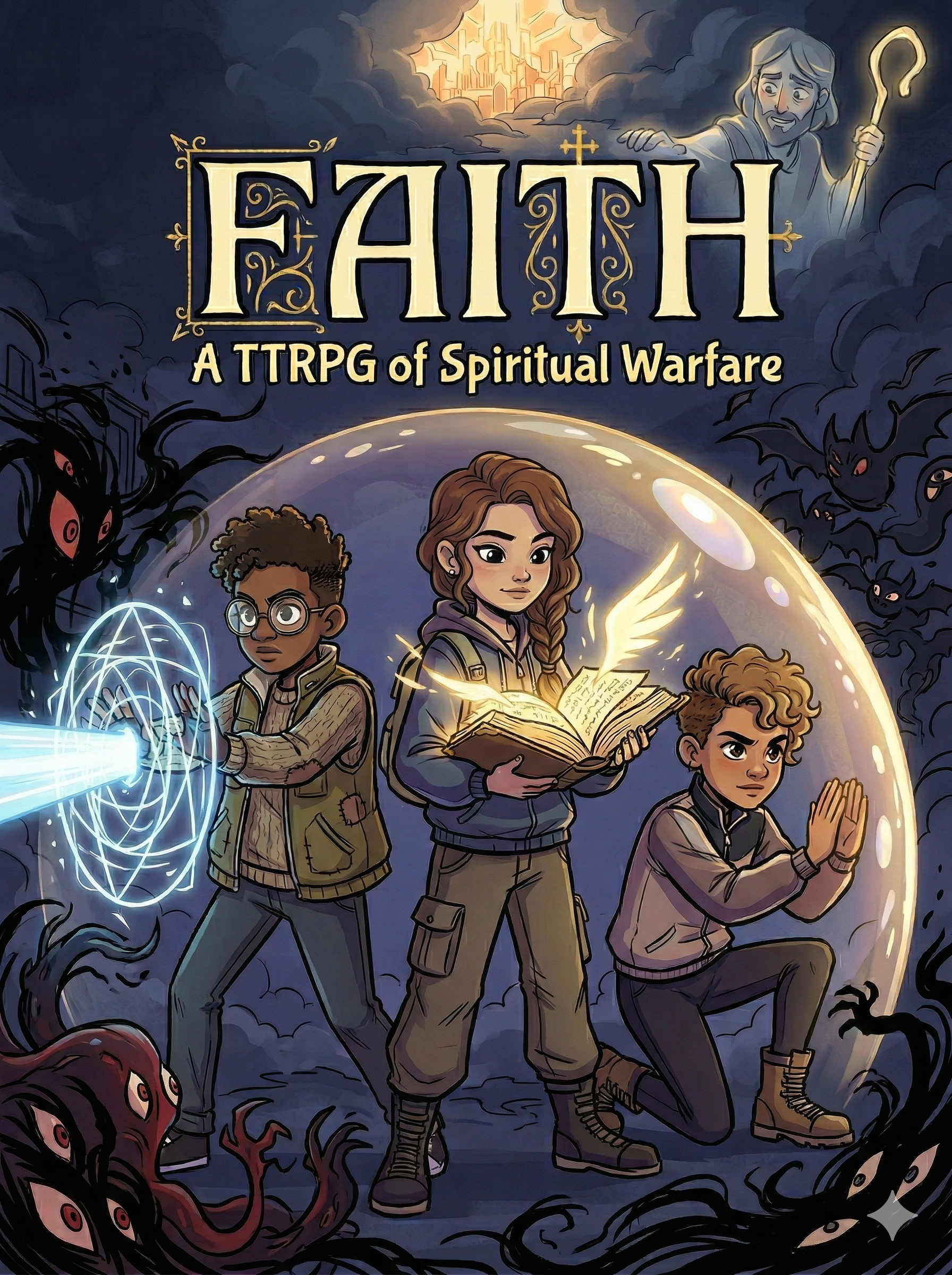
Faith Core Rulebook by Rutz Studios on DevLoot
Faith is an original Christian TTRPG from Rutz Studios where characters grow through Fruits of the Spirit instead of stats like Strength and Dexterity, and a central Faith Die mechanic rewards playing by conviction rather than raw power. That framing makes it a natural fit for family tables, church youth groups, and homeschool co-ops: the themes are cooperation, character, and courage, and there is nothing a parent needs to edit on the fly. The Core Rulebook runs $19.99, and if you are the one running the game, The Shepherd's Companion is the $4.99 GM guide with campaign structure and ready-made Trials, which saves a new family GM a lot of prep. To be clear about who it is for: if your family is not religious, this will not be your game, and that is fine. If it is, this is one of the few systems built for you from the ground up rather than adapted after the fact.
Your next step: one tiny adventure this weekend
Do not plan a campaign. Plan 45 minutes. One village, one problem, one cave, one small treasure, one complete ending. Pick the system that fits your youngest player, print or sketch a picture-friendly character sheet, and put the phones in another room. If the kids ask "can we play again tomorrow," you ran it right.
And if the wheels do come off halfway through because someone decided their wizard lives in the dragon's nostril now, congratulations. That is not a failed session. That is the hobby working exactly as intended.
Hero photo: Dice and Character Sheet, Wikimedia Commons. Product image courtesy of Rutz Studios.
.jpg)