NPC Daily Schedules in Unity: Make Your Game Creator 2 Town Feel Alive (No Code)
Walk into the town square of almost any indie RPG and watch the citizens for sixty seconds. The blacksmith hammers the same anvil at 3 a.m. that he hammered at noon. The innkeeper stands bolted behind her counter whether the tavern is packed or empty. A villager paces the same ten meter loop he has paced since the scene loaded. The environment art might be gorgeous, the lighting might be perfect, and none of it matters, because the moment a player notices that nobody in this town actually lives here, the illusion pops like a soap bubble.
Players are brutal about this. They will forgive muddy textures and stiff animations long before they forgive a world that ignores them. What sells a town is not the buildings. It is the feeling that the people in it have somewhere to be. The baker opens her shop in the morning because she is hungry for customers, heads to the fountain at lunch because she is social, and drags herself home at dusk because she is tired. That is what turns a level into a place.
Why hand-rolled NPC routines fall apart
Every developer who has tried to build this by hand knows how the story goes. Version one is a waypoint loop. It looks fine for a day. Version two adds a state machine: Idle, Walk, Work, Sleep. Then the edge cases arrive. An NPC gets hungry mid-commute and the state machine yanks him toward food, then the schedule yanks him back to work, and he flickers between the two like a haunted roomba. Tick-based updates re-evaluate every frame, so any two competing motivations produce exactly this oscillation unless you write an ever-growing pile of guard clauses.
Then comes the scaling problem. One scheduled NPC is a scripting exercise. Thirty of them, each checking distances to every shop, bench, and bed in the scene, is a frame budget problem. And once the sun sets on your dynamic time system, you discover the schedule system, the needs system, the pathfinding, and the animation layer all need to agree with each other, or the town devolves into interpretive dance.
For a Game Creator 2 project the usual answer has been worse: there was no real answer. GC2 gives you superb characters, triggers, and visual scripting, but a full civic simulation layer, with needs, jobs, schedules, and memory, was something you wrote yourself in C# or simply cut from scope.
A town does not feel alive because it has more NPCs. It feels alive because every NPC has a reason to be where they are.
A civic system you drop in instead of writing
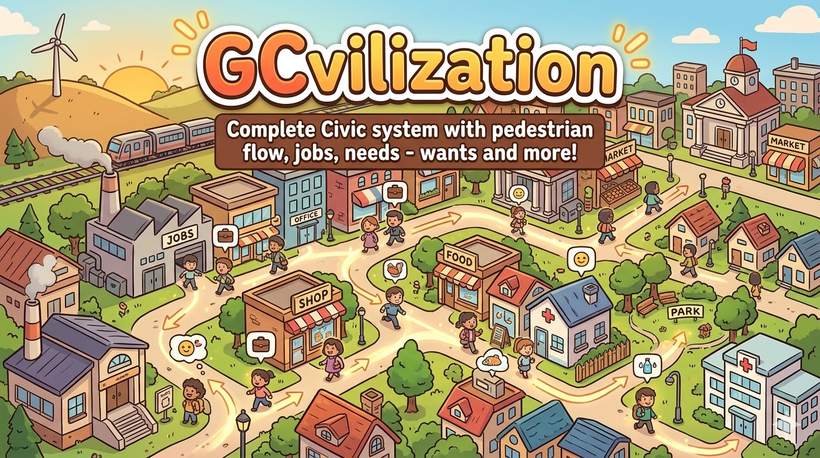
This is exactly the gap GCvilization, a full civic system for Game Creator 2, was built to fill. It is a life simulation NPC framework from Rutz Studios, the same creator behind the fishing and farming modules we have covered before, and it ships the entire "living town" layer as a drop-in package: needs, personalities, daily schedules, memories, and a decision-making brain, all wired into GC2 visual scripting with zero coding required.
Instead of a state machine you babysit, every citizen runs on a utility-based brain. When an NPC has to decide what to do next, the system scores the options against three inputs: how urgent each of their needs currently is, what their daily schedule says they should be doing, and what their personality nudges them toward. The highest score wins. A hungry Foodie skips the park and heads for the food stall. A Workaholic ignores a mildly rumbling stomach until the shift ends. Nobody flickers, because of a design decision worth calling out on its own.
Blocking states instead of tick polling
GCvilization runs each NPC state as a dedicated coroutine that keeps control until the action finishes or an urgent need interrupts it. There are no per-frame state re-evaluations fighting over the character. That single architectural choice kills the flicker problem that plagues homemade systems, and it is also cheaper: no polling means no army of update ticks grinding your CPU every frame. Add the framework's spatial hashing for object lookups and the system stays comfortable with a town's worth of citizens, not just a demo scene's worth.
Six needs, real personalities, actual memories
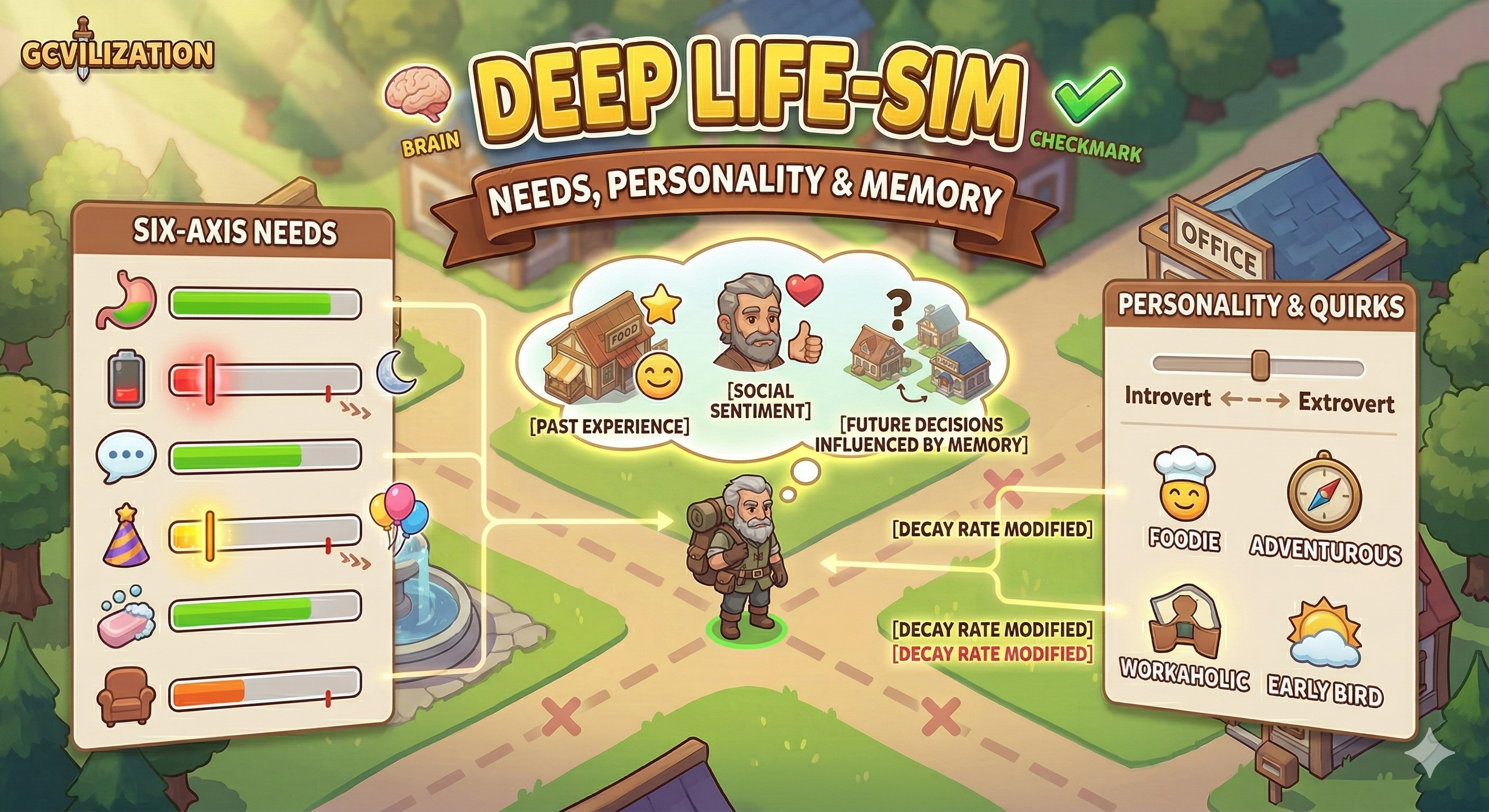
Citizens are driven by six core needs: Hunger, Energy, Social, Fun, Hygiene, and Comfort. Each decays over game time at rates you configure, and each has urgency thresholds that can interrupt whatever the NPC is doing, which is how lunch breaks and midnight snack runs emerge on their own. On top of that sit continuous personality traits like Introversion and Adventurousness, plus discrete quirks such as EarlyBird, Foodie, or Workaholic that modify decay rates and preferences. Two NPCs with the same schedule will still live visibly different days.
The layer that surprised us most is experiential memory. Citizens remember what happened to them and factor it into future choices. A great meal at the food stall makes a return visit more likely. That is the kind of detail players never consciously notice and always subconsciously feel.
Zero code, native GC2 nodes
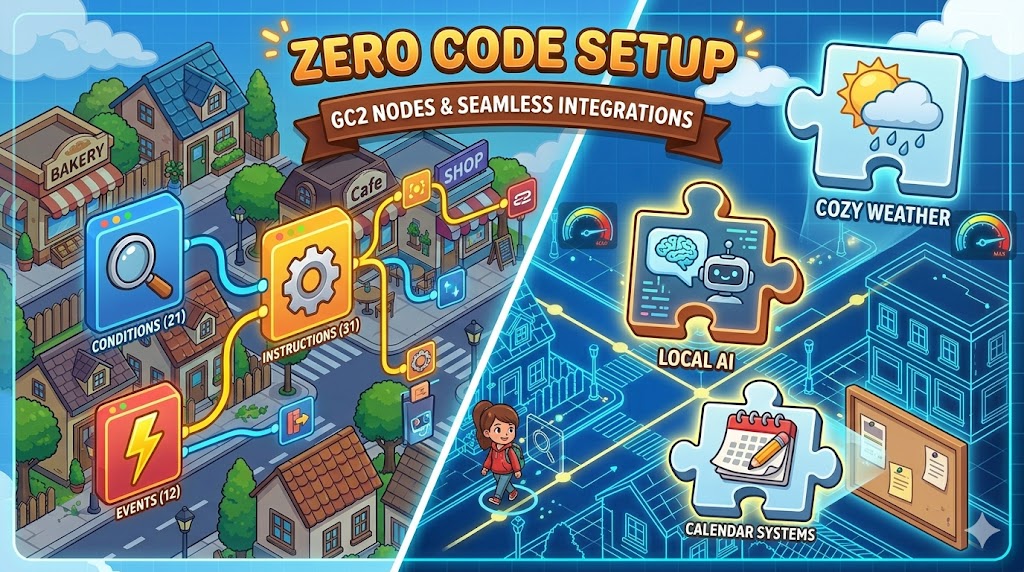
Everything above is exposed through 69 native Game Creator 2 visual scripting nodes, including instructions, conditions, events, and triggers. Want a quest that only fires when the merchant is actually at her stall? That is a condition. Want a festival that overrides everyone's schedule for the evening? Instructions. You orchestrate the town the same way you already build the rest of your GC2 game, and the package has no hard dependencies beyond that, so it drops cleanly into an existing project.
Who actually needs this
If you are building a cozy village sim, a town-centered RPG, a shop game where customers should feel like regulars, or any project where players spend real time around NPCs, this is squarely for you. It pairs naturally with the rest of the GC2 cozy stack: give your farm from a farming system like Easy Farming a village of customers who wake up, work, and gossip around it, and suddenly the player is not farming in a vacuum.
It also slots neatly under conversational AI. We recently looked at local AI NPC dialogue in Game Creator 2, which makes NPCs worth talking to. GCvilization is the other half of that equation: it makes them worth watching. The product page lists ready integrations for the Local AI module alongside weather and calendar systems, so the blacksmith who remembers your last conversation can also be found at the tavern after work, which is exactly where a blacksmith should be.
Solo developers and small teams benefit the most here. A civic simulation of this scope, with a stable utility brain, interrupt handling, and performance work like spatial hashing already done, is months of programming. At $49.99 on DevLoot it costs less than a day of contract programming time.
The honest read
Is it overkill for a game where NPCs are set dressing glimpsed from a speeding car? Yes. Buy it for the game where the town is a character. You will still spend real design time placing work sites, tuning decay rates, and writing schedules that fit your world, because the framework simulates citizens, it does not design your town for you. That is the correct division of labor: you decide who these people are, GCvilization makes them live it, minute by minute, without a line of C#.
If your village still sleepwalks through its days, get GCvilization on DevLoot and give your citizens somewhere to be. Your players will notice within sixty seconds. This time, that is a good thing.