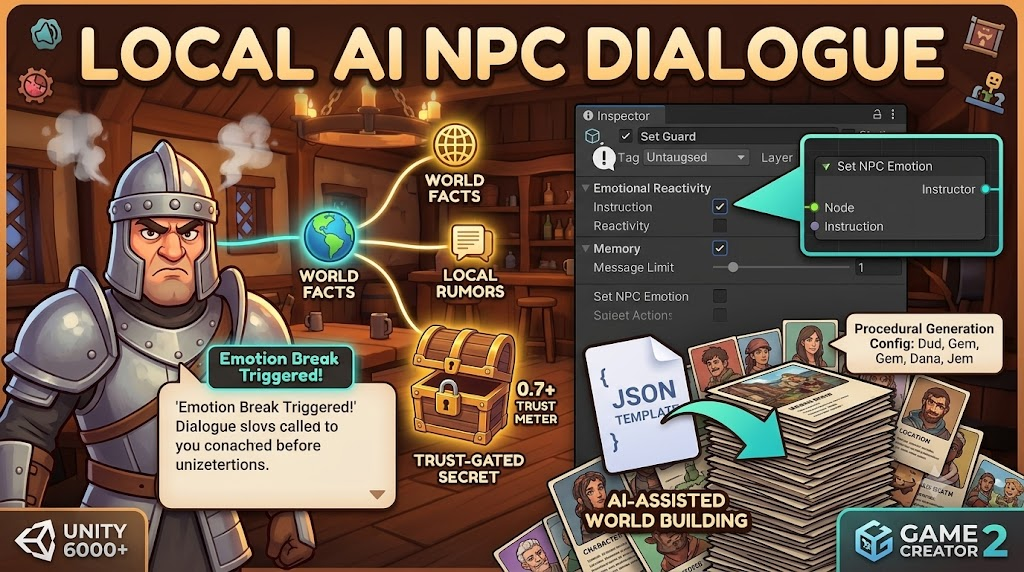
AI NPC Dialogue in Unity, Fully Offline: Real Conversations for Game Creator 2 Characters
Every RPG developer knows the moment. A playtester walks up to the innkeeper you spent a weekend writing, clicks through her three dialogue options in forty seconds, and never talks to her again. Worse, on the next visit she repeats the same lines word for word, as if the player's last conversation never happened. Your world is full of characters, and none of them can actually hold a conversation.
Dialogue trees are the industry standard for a reason. They are predictable, testable, and quest-safe. But for solo devs and small teams they carry a hidden tax that never stops compounding: every line is hand written, every branch multiplies the writing work, and every NPC you add makes the problem bigger. Most of us quietly settle for a world where ninety percent of characters say one canned bark on repeat. Players notice.
Why cloud AI NPC dialogue never made it into shipped games
The obvious fix has been floating around for a while now. Wire your NPCs to a large language model and let players type anything. The tech demos are impressive, and yet almost nobody ships this. The reasons are practical, not technical. A cloud API means every single player message costs you money, forever, scaling with your player count instead of your revenue. It means your game requires an internet connection for a core feature. It means an API key baked into your build or a relay server you now have to maintain. And it means that if the provider changes pricing or deprecates a model, a shipped game breaks on its own.
For a free demo weekend or a viral streamer moment, per-message billing can turn a good day into an expensive one. That math kills the feature before it starts for most indies.
Running the model on the player's machine instead
This is the problem the Local AI Game Creator 2 Module by Rutz Studios was built to solve, and it takes the route that actually makes sense for shipped games: the model runs locally. The package bundles a ready-to-use 7B language model and an inference server directly into your Unity project. No cloud service, no API key, no internet requirement, and no per-message costs, ever. What you ship is what players get, and it keeps working in ten years regardless of what any AI company does with its pricing page.
The result, in play, is the thing dialogue trees never gave us. Players type whatever they want, and the character answers in her own voice.
The blacksmith answers in her own voice, remembers you from yesterday, warms up as you earn her trust, and storms off if you push her too far.
Characters, not chatbots
The part that separates this from a raw LLM wrapper is the authoring layer. Each NPC gets a Character Profile: identity, personality, speech style, backstory, pinned facts the AI can never contradict, and secrets that only unlock once the player has earned enough trust. Profiles are plain ScriptableObjects, the same asset-based workflow Unity devs already use everywhere else (if you want a refresher on why that pattern is so useful, our guide on when to use ScriptableObjects covers it). Author one villager by hand, or generate a hundred background characters from pools of names, traits, occupations, and quirks with the built-in procedural NPC generator.
Pinned facts matter more than they sound. The biggest fear with AI dialogue is an NPC inventing lore or contradicting your quest state. Pinned facts are hard constraints, and preset dialogue choices can still fire regular game events, so quest-critical beats stay fully deterministic while the small talk around them stays open-ended.
Emotions with mechanical teeth
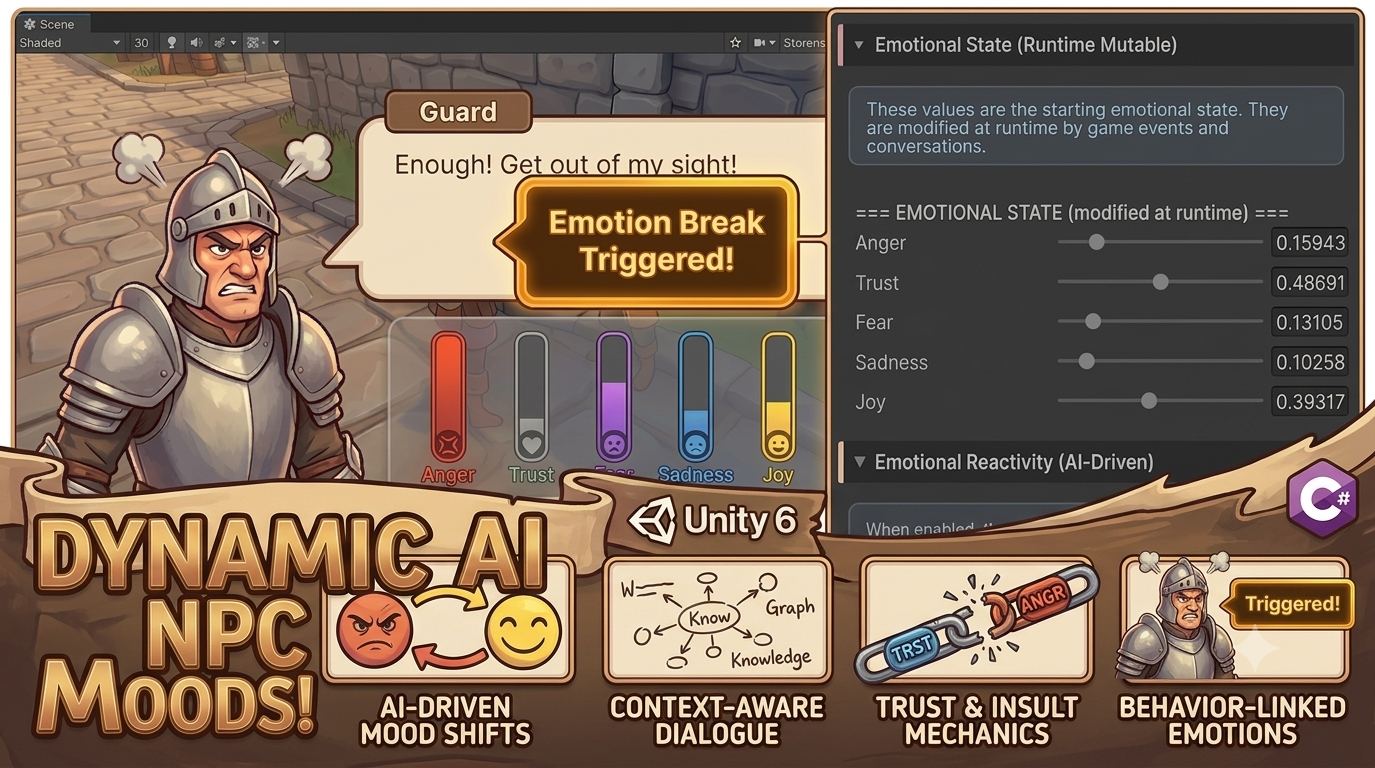
Five live emotions (anger, trust, fear, sadness, joy) shift naturally as the conversation goes and color every reply. An insulted guard switches to short, hostile sentences. A delighted innkeeper gushes. And when an emotion crosses a threshold you define, the conversation breaks: the NPC delivers a closing line and hands control back to your game logic, so the guard can storm off, call for backup, or attack. Mood stops being a portrait swap and becomes a system your gameplay can react to.
Memory and layered knowledge
NPCs remember past exchanges within a session, and with the drop-in Memory Persistence component they remember across save games too. Knowledge is layered the way it should be: world facts everyone knows, regional facts, local rumors, occupation knowledge, and personal secrets. A fisherman in the northern village knows fishing and northern gossip. He does not know what the king said in the throne room, because he was never there. Characters only know what they plausibly should, which does more for immersion than any amount of prose.
Built for Game Creator 2, not bolted onto it
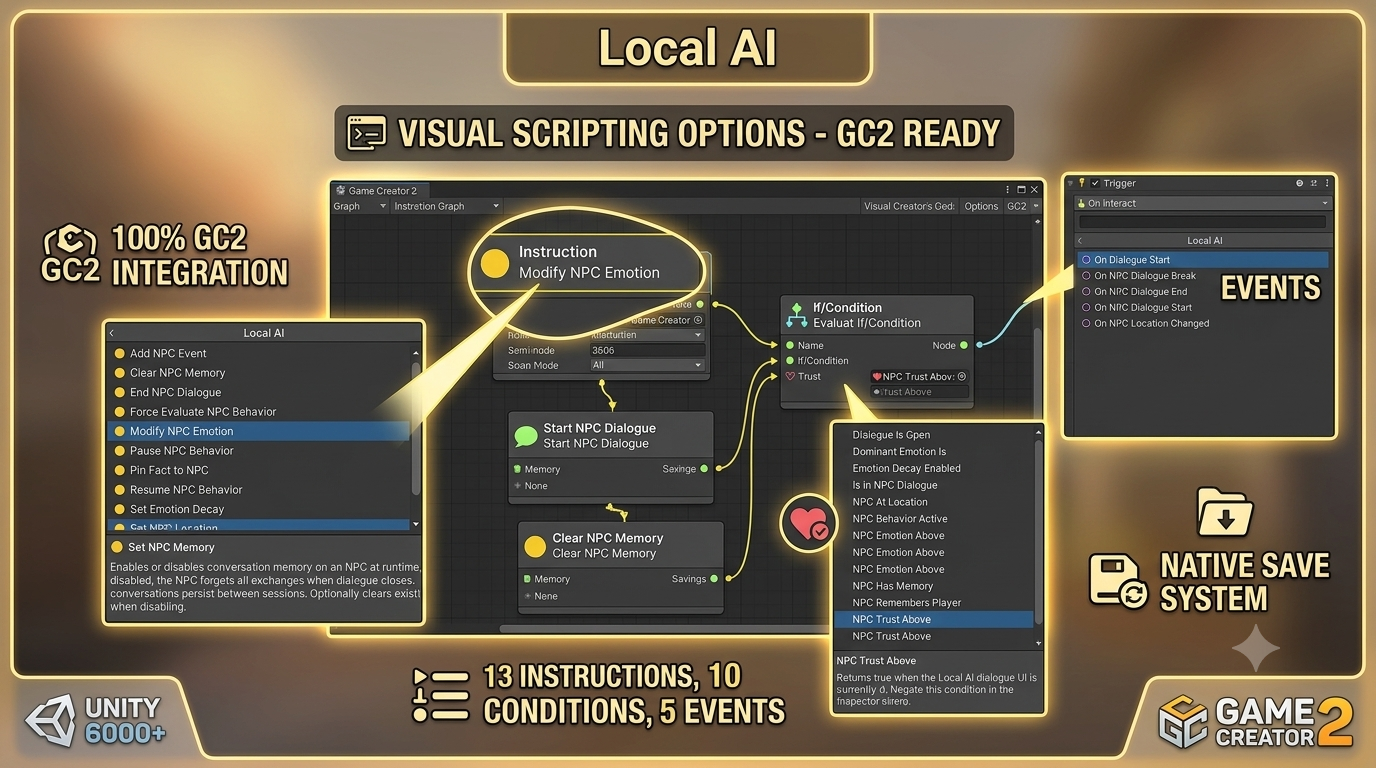
If you build with Game Creator 2, this slots into the workflow you already have. The module ships 13 instructions, 10 conditions, and 5 triggers for GC2 visual scripting: start and end dialogue, modify emotions, set trust, pin facts at runtime, inject world events, and react when a dialogue opens, closes, or breaks. It supports the native GC2 save system, so conversations, moods, and memories survive save and load without custom code. Walk-up-and-talk works out of the box, or you can open dialogue from any trigger you like. We have seen before how far GC2 visual scripting can carry a full mechanic without code, for example in our look at building a Stardew-style fishing minigame in GC2, and this module follows the same philosophy.
Speed, hardware, and the honest fine print
Local inference lives or dies on responsiveness, and the design here is sensible. Replies stream in word by word the moment the model starts writing, so there is no frozen screen while a full response generates. Per-NPC response caching keeps mid-conversation replies starting in about a second on a mid-range GPU, and a request queue protects your frame rate no matter how many NPCs share the scene.
Now the fine print, because you should know it before you buy. This is Windows only for now, targets Unity 6000.0 and newer, requires Game Creator 2, and strongly recommends a dedicated NVIDIA GPU with 6 GB or more of VRAM. The bundled model adds roughly 5 GB to your project and your builds. That is the real cost of offline AI, and it is worth weighing against your target audience's hardware. For a PC-focused RPG, life sim, or immersive sim, that trade is very reasonable in 2026. For mobile, this is not your tool.
Authoring a whole world at AI speed
The workflow feature that sold me is the JSON round trip. Export a template, ask ChatGPT or Claude to fill it with a fishing village of twelve characters, and import the result as ready-to-use profiles, locations, and generator pools. Combined with the procedural generator, populating a region with distinct, talkable background characters goes from weeks of writing to an afternoon of curating. You still do the creative direction. The tooling just removes the typing.
Who this is for
If you are building a PC game in Unity with Game Creator 2 and your design leans on towns, taverns, companions, or social sims, this module turns your flattest content layer into a feature players will actually talk about. It ships with a setup wizard, a complete uGUI and TextMeshPro dialogue UI generator, a demo scene with two NPCs, a 16-page PDF guide, and automatic build packaging so players need zero setup. It also auto-detects the Rutz Emotions package if you use it, syncing conversation emotions with your existing emotion meters.
At $39.98 it costs less than a single week of the cloud API bills it replaces. Have a look at the Local AI Game Creator 2 Module on DevLoot, read the full feature list, and give your NPCs something to say.