
Homebrew vs Published Settings: Which Campaign World Should Your TTRPG Table Use?
You have a group, a free evening every other week, and a system picked out. Now comes the question that stalls more new campaigns than any rules argument: do you run the game in a published setting, or do you build your own world from scratch?
Ask this in any GM forum and you get two camps. One says homebrew is the heart of the hobby. The other says life is short and somebody already drew the map. Both are right about something, and both skip over the costs. I have run long campaigns each way, plus one disaster that tried to do both badly, so here is the honest comparison.
What a published setting really gives you
A published setting is a world someone else has already written, tested, and illustrated. The Forgotten Realms, Eberron, Golarion for Pathfinder, the haunted city of Doskvol in Blades in the Dark. You buy the book and the world exists.
The obvious benefit is saved time. The less obvious benefits matter more:
- Shared vocabulary. When a player already knows what Waterdeep is, you skip twenty minutes of explaining. They arrive with opinions, and opinions are fuel.
- Depth on demand. A player asks what the local currency is called, and the answer is on page 114 instead of in your panicked imagination.
- Professional polish. Maps, art, and factions that have been through editors. Showing a real illustration of the city beats describing it for the third time.
- Ready adventures. Most big settings have modules built for them, which is a gift on the weeks when work eats your prep time.
The costs are real too. Big settings come with decades of canon, and it can feel like homework. There is also the lore expert problem: one player who has read every novel and politely corrects your version of events. And some GMs simply never feel ownership. The world stays a rental.
What homebrew really gives you
Homebrew means you write the world yourself. Nobody can tell you that you got it wrong, because there is no wrong. Every secret is truly secret. No player can look up the villain's plan on a wiki.
The bigger win is fit. A homebrew world can be shaped around your specific players. If one of them wants to play a disgraced river pilot, you can make rivers the highways of your world by next session. A published setting can bend that way, but a homebrew one is built from that material in the first place.
The cost is not what people expect. It is not the hours, because world writing is fun and most GMs would do it anyway. The cost is that your players start with zero knowledge and zero attachment. Nobody cares about your elven succession crisis yet. You have to earn every bit of investment at the table, one scene at a time, and a twelve-page lore handout will not do it for you. (We covered how to earn that attention in our worldbuilding tips for campaign settings.)
The other risk is burnout. Building a continent before session one is a classic way to be exhausted by session four.
The line between them is thinner than it looks
Here is something that changed how I think about this debate. Almost every famous published setting started life as somebody's homebrew.
Greyhawk grew out of Gary Gygax's own home campaign before it saw print as a folio in 1980. Ed Greenwood had been writing about the Forgotten Realms since childhood, long before TSR published it as a campaign set in 1987. Eberron was Keith Baker's entry in a Wizards of the Coast setting search in 2002, chosen from more than 11,000 submissions and published in 2004. Exandria, the world of Critical Role, was Matt Mercer's home game before it became a line of official books.
Every published setting is a homebrew world that got an editor. The question is not which kind is better. It is whose work you want to start from.
And the reverse holds as well. The moment you run a published setting, it becomes yours. Your Waterdeep has an innkeeper who does not exist in anyone else's. Three sessions in, your version of the world has drifted from the book, and that is the point.
The hybrid approach most experienced GMs settle on
After a few campaigns, most GMs I know stop choosing sides and land somewhere in the middle. There are three common ways to do it.
1. Borrow the frame, write the town
Use a published world for the big picture (gods, nations, history) and invent the local region yourself. You get depth on demand for the far-off stuff and total freedom where the players really spend their time.
2. Homebrew the world, steal the adventures
Build your own setting, then drop published adventures into it with the names changed. A good dungeon does not care which continent it sits on. This pairs nicely with a low-prep, improvise-more style of GMing, since you only build what the next session needs.
3. Use a game with a strong premise and a loose map
Some games hand you a clear tone, a theme, and tools for building locations, without locking you into hundreds of pages of canon. You get the direction of a published setting and the ownership of homebrew.
Where a themed game fits: the Faith line on DevLoot
That third option is worth a concrete example. Faith: Core Rulebook by Rutz Studios is a Christian tabletop RPG sold here on DevLoot ($19.99, PDF). It is a faith-based game by design, built around the idea of playing "by faith, not by sight," with a Faith Die at the center of its mechanics.
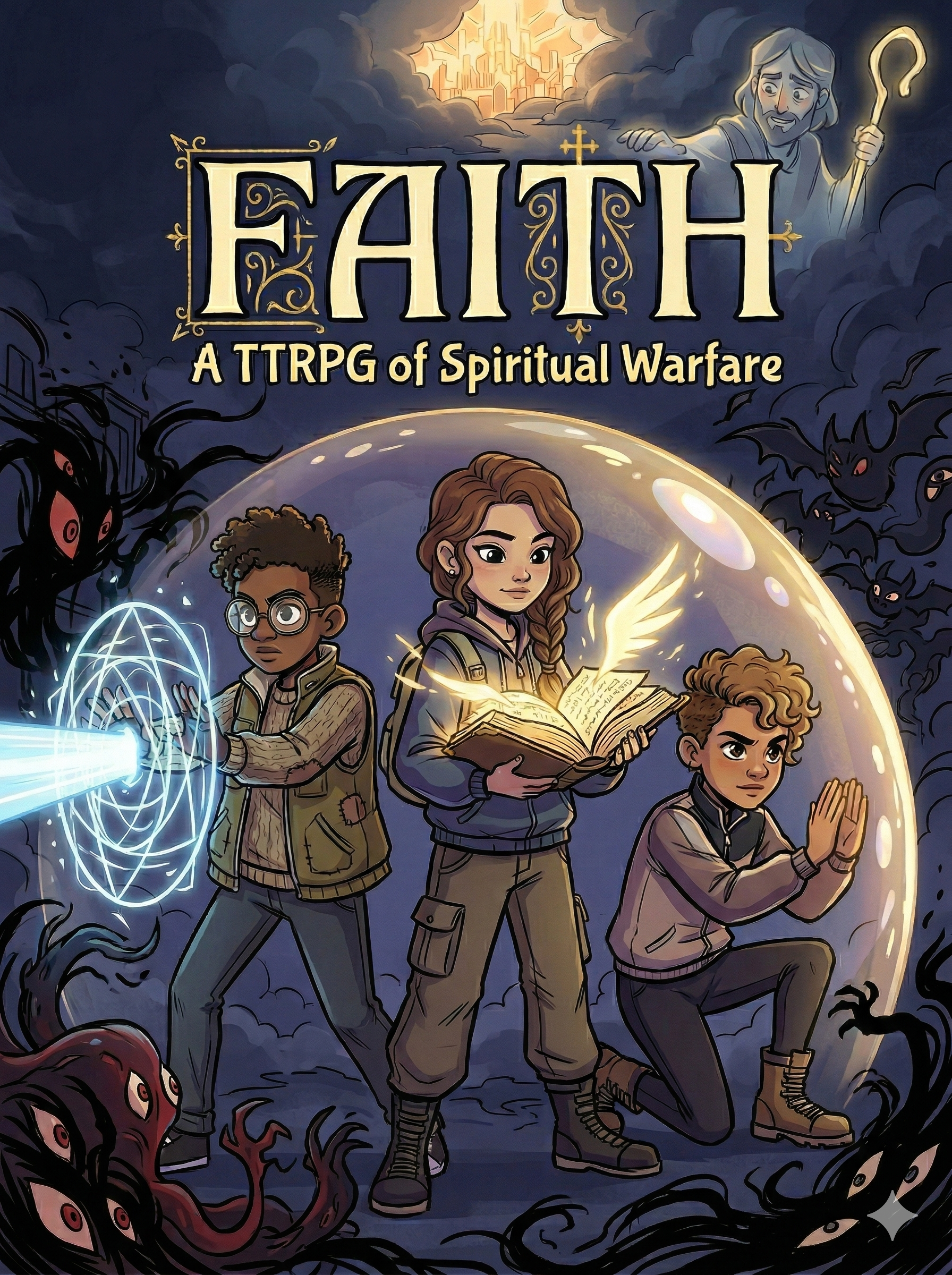
Cover: Faith: Core Rulebook by Rutz Studios, on DevLoot.
What makes it relevant to this debate is the companion book. The Shepherd's Companion ($4.99) is the guide for the game's GM, called the Shepherd, and its listing covers running campaigns, crafting Trials, and building the worlds your group plays in. So the game supplies the theme and the tools, and your table supplies the map. That is the hybrid model in practice.
Who is it for? Church groups, families, and players who want a game where their beliefs are part of the story instead of something to work around. If that is not your table, that is fine, and the same structure exists in plenty of secular games. If you are curious about the wider niche, we wrote an overview of faith-based tabletop RPGs and who they suit.
A quick way to decide
If you are still stuck, answer these four questions.
- How much prep time do you have per week? Under two hours, lean published or hybrid. Building a world and prepping sessions at once is a lot.
- Do your players already love a setting? If the whole group lights up at the mention of one world, run it. Enthusiasm you do not have to manufacture is rare.
- Is making things the fun part for you? If drawing maps on a Sunday afternoon is your hobby, homebrew. A GM who enjoys the prep runs better games.
- Is this your first campaign? Start small either way. One town, one threat, one map. You can attach it to a published world or a homebrew one later, and nobody at the table will notice the seam.
The short version
Published settings trade ownership for speed and shared knowledge. Homebrew trades speed for fit and surprise. Most long-running tables end up blending the two, and the famous settings on your shelf are proof that the border between them was never very firm.
So pick the one that makes you want to prep this week, and start with a single town. If a themed game with room for your own world sounds right, take a look at the Faith Core Rulebook. Otherwise, open a notebook or a setting book tonight and write down one place your players can walk into. That is a campaign world. The rest can wait until they ask.
Hero image: "AD&D Dungeon Masters notebook" by Steve Jurvetson, Wikimedia Commons, CC BY 2.0.
