
TTRPG Worldbuilding Tips: How to Build a Campaign Setting Your Players Care About
Every GM hits the same wall eventually. You have a notebook full of kingdoms, a pantheon of twelve gods, a thousand years of history, and a map you spent three evenings drawing. Then the players sit down, ignore all of it, and spend forty minutes haggling with a fishmonger. Sound familiar?
That is not a player problem. It is a worldbuilding problem. Most of us build settings the way novelists do, top down and complete, when a tabletop game needs something different: a world that is small, reactive, and full of hooks the players can actually grab. Here is how I build campaign settings now, after years of writing lore nobody read.
Start with the table, not the map
Before you name a single continent, answer three questions. What kind of stories does this group want? What do the characters do all day? And what is the one thing that makes this world feel different from generic fantasy (or sci-fi, or horror)?
That third question is your hook. "Magic is illegal and everyone secretly uses it." "The sun has not risen in forty years." "Every town is built on the back of a sleeping giant." One sentence like that does more work than fifty pages of trade routes, because every scene you run can bounce off it.
If you have not run a session zero yet, this is exactly the moment to do it. Our guide to session zero and safety tools covers how to get the whole table's expectations out in the open before you commit to a tone.
Build inside out: the starting town first
The classic mistake is building the world from the outside in: cosmology, then continents, then nations, then finally the village where the game starts. Flip it. Build the place the characters will stand on in session one, in detail, and leave everything beyond the horizon as a rumor.
For a starting location, you really only need:
- Three named NPCs with a want and a secret each. The innkeeper who is behind on debts. The priest who knows what is under the chapel. The kid who sees everything.
- One problem that is already happening when the players arrive. Not a quest giver waiting politely, but something in motion.
- Two or three rumors that point outward, toward places you have not built yet.
Those rumors are your worldbuilding roadmap. Whichever one the players chase, that is what you build next. You will never waste an evening on a region nobody visits.
Write secrets, not encyclopedia entries
Mike Shea (Sly Flourish) popularized a technique in Return of the Lazy Dungeon Master that changed how I think about lore. Instead of writing history as prose, write it as a list of short secrets and clues: a sentence or two each, things the characters would want to know, that you can reveal wherever they fit during play. His guidance is roughly ten per session, and you do not decide in advance where each one appears.
Lore that never reaches the table is not worldbuilding. It is a diary. Write the world in pieces small enough to hand to a player.
Compare these two approaches. The encyclopedia version: "The Order of the Grey Lantern was founded 300 years ago by the exiled knight Varen to guard the northern passes." The secret version: "The Grey Lantern knights are not guarding the pass from what comes down. They are guarding it from people going up." The second one is a story. The players can find it in a journal, overhear it from a drunk knight, or read it on a tombstone. Same world, far more useful.
This pairs beautifully with the low-prep mindset. If you want the full version of that workflow, read how to prep less and improvise more.
Give every faction a clock
A world feels alive when things change whether or not the players are watching. The easiest way to fake that is to give each major faction a goal and a short list of steps toward it. The cult wants to wake the drowned god: step one, steal the bell; step two, silence the lighthouse; step three, the ritual at the new moon.
Between sessions, ask yourself what each faction did. Advance a step if it makes sense. Now when the players return to town, the lighthouse is dark and nobody knows why. They did not cause it, but they can still stop what comes next. That single habit does more for immersion than any amount of backstory.
Let the players build some of it
You do not have to carry the whole world alone, and honestly, you should not. Players care far more about the parts they invented. A few easy ways to share the load:
- Ask each player to name one place their character is from and one person from their past who still matters.
- When a character enters a tavern for the first time, ask the player what the place is famous for.
- Let a character with a relevant background answer a lore question instead of you. "You grew up near the swamp. What do the locals say lives out there?"
If your group loves this, try Microscope by Ben Robbins (Lame Mage Productions, 2011). It is a GM-less game where everyone builds a history together on a timeline, then zooms in to play out specific moments. Plenty of groups use a round of it to generate a shared setting before a campaign starts. It is a fantastic way to make the world belong to the whole table.
Themed worlds need a core idea, not just decoration
This matters most when your setting is built around a theme: cosmic horror, cozy village life, hard sci-fi, or a faith-centered game. The theme has to shape how the world works, not just what it looks like. In a horror setting, knowledge should cost something. In a cozy game, the stakes are relationships and seasons, not empires. A theme that only lives in the scenery will fade by session three.
A good example of a system that builds this into its structure is Faith, an original Christian tabletop RPG from Rutz Studios sold here on DevLoot. (We covered the wider niche in our look at faith-based tabletop RPGs.) Faith is aimed at groups who want a game rooted in Christian belief, and the GM role is called the Shepherd. Its GM guide, The Shepherd's Companion, focuses on exactly the parts of worldbuilding that matter at the table: running campaigns, designing Trials for the characters to face, managing the game's Faith Die mechanic, and building what the book calls sacred worlds, settings where the theme is part of the rules rather than a coat of paint.
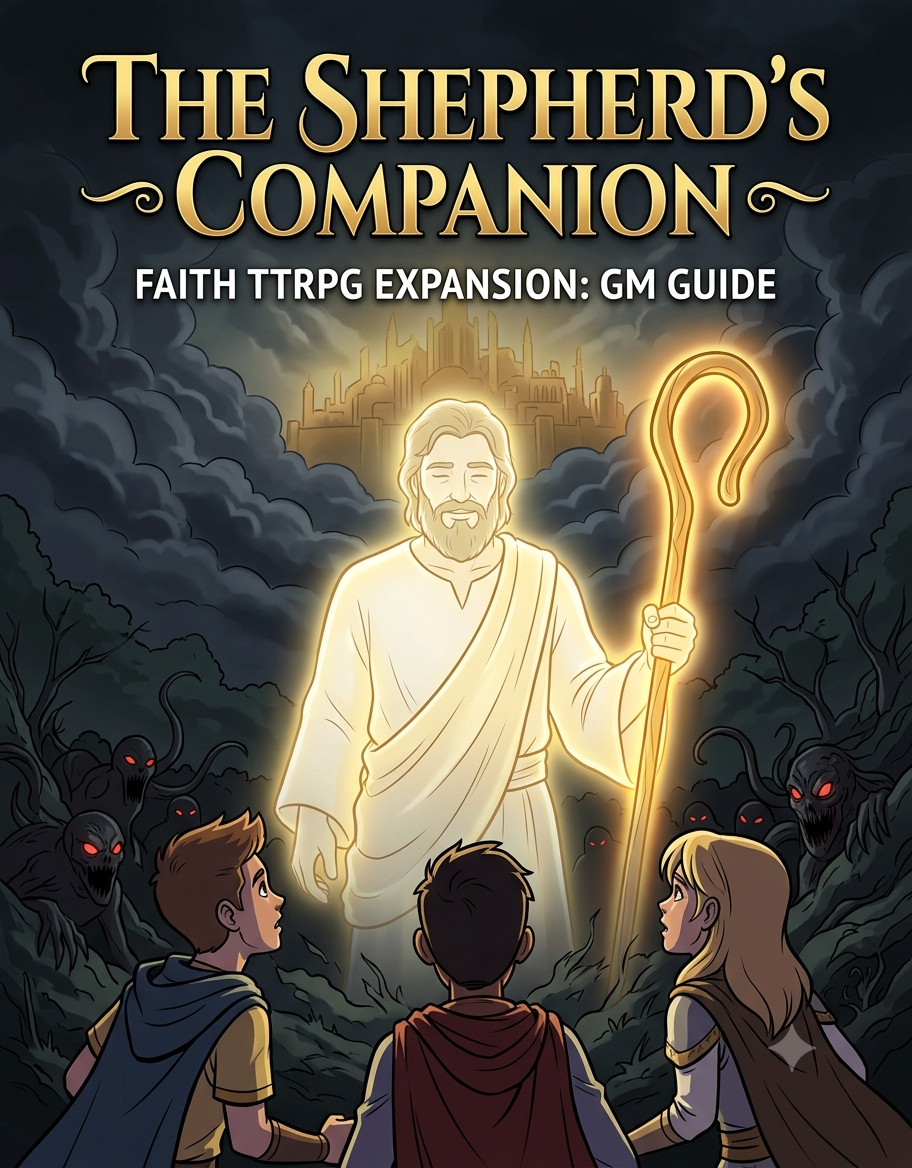
Cover: Faith: The Shepherd's Companion by Rutz Studios, on DevLoot.
It is $4.99, and it is built to sit alongside the Faith Core Rulebook ($19.99), so it is for groups already interested in that game rather than a general worldbuilding manual. If that is your table, it is a sensible, inexpensive way to get a head start on a setting that fits the system. If it is not, the takeaway still applies: let your theme change the rules of your world, not just the wallpaper.
Keep a living setting document
Finally, your world needs a home that is not your memory. After every session, spend ten minutes updating one document with:
- New names you improvised (you will forget the fishmonger, and the players will not).
- Secrets that were revealed, so you stop reusing them.
- Faction clock progress.
- Threads the players seemed excited about.
That last list is the most important thing you will write all week. It tells you what to build next. Over months, that document turns into a real setting, one shaped by play instead of imagined in a vacuum. And it will be better than anything you could have written alone before session one.
Your next step
Pick your one-sentence hook tonight. Then build a single starting town with three NPCs, one active problem, and three rumors pointing outward. That is enough to run a great first session, and everything else can grow from what your players actually do. If you want more tools for your table, browse the tabletop section on DevLoot.
Hero image: "View from behind the screen" by Graham Campbell, Wikimedia Commons, CC BY-SA 2.0.
.jpg)