
Solo TTRPG Play: How to Run a Whole Campaign Without a Group
The hardest mechanic in tabletop roleplaying is not grappling. It is scheduling. Four adults, one evening, every other week, for six months. Far more campaigns die in a group chat than at the claws of a dragon.
Solo roleplaying is the answer a growing number of players have quietly landed on. You sit down with a game, a notebook, and some dice, and you play. No group, no calendar negotiation, no waiting on the person who always cancels at 6:45. It sounds like it should not work. It works better than most people expect, and the reason comes down to one tool.
What solo TTRPG play actually is
In a normal game, the GM does two jobs. They author the world, and they answer questions. Is the guard bribable? Does the ritual work? Is there anyone else in the crypt? Playing solo does not mean you take over both jobs, because if you author everything and also answer everything, you are just writing a story. Nothing can surprise you.
So solo play splits the difference. You keep the authoring. You hand the answering to a random system called an oracle. That is the whole trick. Everything else is variation on it.
The oracle is the engine
An oracle is a procedure for turning a question into an answer you did not choose. The simplest version is a d6: 1-2 no, 3-4 yes but complicated, 5-6 yes. That alone will carry a session.
Most published oracles add three refinements worth knowing:
- Likelihood. Before you roll, you rate how probable the answer is. "Is the gate guarded?" at a fortress is likely, so you shift the odds toward yes. This keeps the world consistent instead of random.
- Yes, and / no, but. Degrees of success, borrowed straight from improv. A strong yes escalates. A weak no leaves a door open. This is what stops a solo game from stalling on a flat refusal.
- Meaning tables. Two columns of evocative words, usually a verb and a noun. Roll "Withhold" plus "Debt" and your brain does the rest. These handle the open questions a yes-or-no roll cannot, like "what is actually going on in this village?"
The Mythic Game Master Emulator from Word Mill Games is the best known standalone version, and its second edition (2023) is the one most solo players use. It bolts onto any system you already own. Its signature idea is the Chaos Factor, a dial from 1 to 9 that tracks how much the situation is running away from your character. High chaos means more interruptions, more unexpected scenes, more of the world acting on you. It is a surprisingly good model of narrative pressure.
Solo play does not mean you tell yourself a story. It means you ask a question you cannot answer, and then you have to live with what comes back.
Three ways in, depending on what you want
1. A system built for it
Ironsworn by Shawn Tomkin is the standard first recommendation, and the recommendation holds up. It is a low fantasy game about swearing oaths and paying for them, the oracles are built into the book rather than bolted on, and the PDF is free on itch.io and DriveThruRPG, where it has been one of the most downloaded free RPGs for years. It supports three modes out of the box: solo, co-op with no GM, and traditional guided play. That flexibility matters, because a solo campaign you start alone can survive a friend joining later.
Its sci-fi successor, Ironsworn: Starforged, is a paid standalone game with a much heavier procedural toolkit for generating sectors, planets, and factions. If your problem is "I want a galaxy to explore and I have nobody to explore it with," that is the book.
2. A journaling game
Journaling games hand you prompts instead of an open world. Thousand Year Old Vampire by Tim Hutchings, self published in 2019, is the one that broke the category open. You chronicle centuries of a vampire's existence through numbered prompts, and because your memory list is finite, you are forced to strike out old memories to record new ones. The mechanic is the theme. It is genuinely affecting, and it plays in a few hours or over months.
The Wretched & Alone family, built on a free Creative Commons SRD derived from Chris Bissette's The Wretched, uses a deck of cards, a tower of blocks, and a tumbling sense of doom. Hundreds of games use that engine now, covering everything from haunted lighthouses to failing space stations. Start there if you want a defined ending rather than an open campaign.
3. An oracle on the game you already own
If you have a shelf of rulebooks, you do not need to buy anything. Pick the game whose world you actually want to spend time in, grab an oracle, and run one character. Note that combat heavy systems designed around a four person party will fight you here, which is worth knowing before you start.
What breaks when you play a group game alone
Three things, reliably.
Encounter math. Most published adventures assume a party. One character walking into a room built for four is not a challenge, it is a mugging. Either play something with a sidekick or companion system, run a small party of two or three characters yourself, or treat fights as scenes to resolve rather than tactical puzzles to win.
Mysteries. You cannot be surprised by a plot you wrote. The fix is to write the question and let the oracle write the answer, at the last possible moment. Do not decide who the killer is. Decide there is a killer, list four suspects, and roll when the evidence forces it.
Momentum. Nobody is waiting on you, so nothing makes you show up. This is the real reason solo campaigns fold. Short sessions beat long ones. Twenty minutes and one scene, ending mid situation, will keep a campaign alive for a year.
A note on themed and niche games
One thing the solo boom has made obvious is that the hobby now has a game for almost any specific interest, including ones that never had shelf space in a hobby shop. We wrote about one such corner in faith-based tabletop RPGs, a niche that goes back roughly forty years and is still producing new systems.
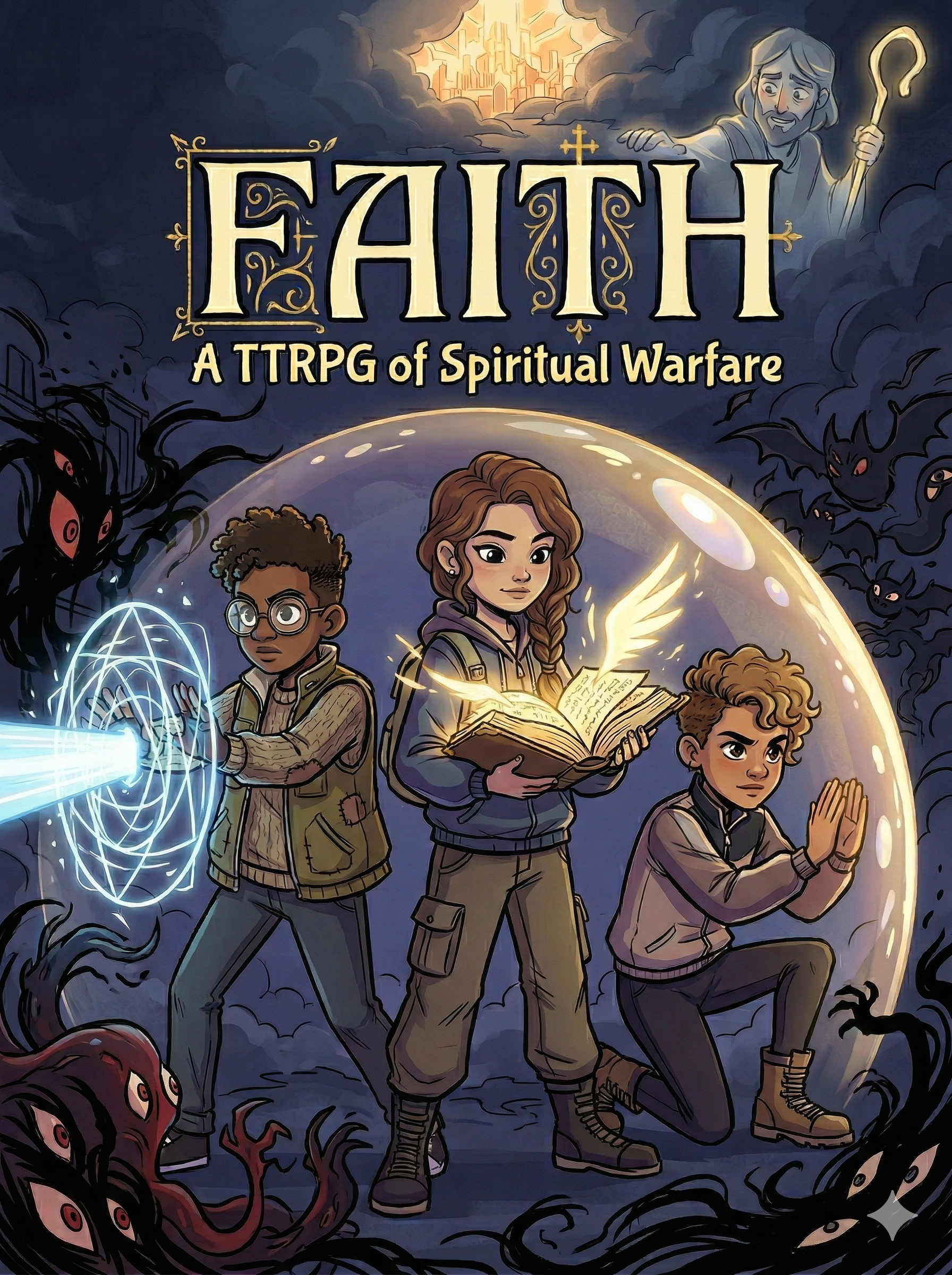
The Faith Core Rulebook by Rutz Studios, on DevLoot.
A current example on DevLoot is Faith, an original Christian TTRPG from Rutz Studios. It is a group game first, run by a Shepherd (its name for the GM), and built around a Faith Die that moves up and down a ladder based on what your character does under pressure. That is worth saying plainly: it is not a solo game, and it is written for players who want their table's stories to sit inside a Christian frame. If that is not your thing, the systems above are.
It does have two pieces that adapt unusually well to playing alone, though. The Faith character sheet ($1) includes a prayer journal section, which is already a solo journaling loop by another name: a character with an inner life, a written record, and a die that judges the gap between the two. And The Shepherd's Companion ($4.99) is a GM guide whose Trial building tools function as prompt generators when there is no GM in the room. The full Core Rulebook runs $19.99.
Habits that keep a solo campaign going
A few things that consistently separate a solo game that lasts from one that dies after two sessions.
- Write in the fiction, not about it. "Rolled a 4, guard says no" is a log. "The guard does not look up from his soup" is a game. The second one gives you something to react to next session.
- Let the oracle beat you. The temptation to reroll a bad answer is enormous and it is the only way to actually lose at solo play. Take the no. Ask what it costs.
- Keep a threat list. Three or four factions or dangers with a simple clock each. When a scene goes quiet, advance one off screen. This is what keeps a world feeling alive without a GM.
- Stop mid scene. End with a question pending. You will come back for the answer.
- Prep almost nothing. The advice in our guide on prepping less and improvising more applies double when you are your own GM. Names, a situation, and a threat list will do.
Where to start this week
Download Ironsworn, since it costs nothing. Make one character, swear one oath, and play three scenes with the built-in oracle. That is maybe ninety minutes, and by the end you will know whether solo play clicks for you or not. If it does, the next question is what world you want to spend a year in, and there is a lot more out there than the big five systems suggest. If you want to see how different games handle the actual rolling, our breakdown of TTRPG dice mechanics covers why a d20 game and a 2d6 game feel so unlike each other at the table.
Browse the TTRPG shelf on DevLoot if you are looking for something outside the usual suspects.
Hero photo: Dice and Character Sheet, via Wikimedia Commons.
.jpg)