
TTRPG Dice Mechanics Explained: d20, 2d6, Dice Pools, and Escalating Dice
Two groups sit down to play. Same adventure, same players. One table uses a d20. The other rolls 2d6 and adds a stat. Half an hour in, those games do not feel remotely alike. The d20 table is loud, because someone just rolled a natural 1 and fell off the wall. The 2d6 table is tense in a slower way, because the rogue keeps landing in that middle band where she gets what she wants and pays for it.
That difference is not flavor text or GM style. It is math. The resolution mechanic is the most opinionated piece of any tabletop RPG, and most people pick a system without ever looking at it directly. So let us look at it directly.
What dice are actually for
Every dice system is a machine for generating uncertainty with a particular shape. Change the shape and you change what the game is about. Two knobs matter more than the rest: the distribution, meaning how likely each result is, and the output, meaning how many kinds of answer a roll can give. Most arguments about dice are really arguments about one of those two.
The d20: flat, swingy, and cinematic
Dungeons and Dragons, Pathfinder, and most of the old-school scene run on a single twenty-sided die. Every face has exactly a 5 percent chance. That is a flat distribution, and it is the reason a d20 game feels the way it does.
Flat means your bonus moves the needle in clean, predictable steps. Going from +4 to +5 buys exactly 5 more percentage points, whatever the target number is. It also means the die dominates the modifier. A character with +5 against a difficulty of 15 succeeds 55 percent of the time, which sounds fine until you notice the untrained guy with +0 still hits it 30 percent of the time. Expertise narrows the gap. It never closes it.
People call the d20 swingy like it is a defect. It is a choice. If you want a game where the apprentice can occasionally out-fight the veteran and one roll can flip a scene, flat is exactly right. If you want competence to feel reliable, it will drive you up the wall.
Bell curves: 2d6 and 3d6
Add dice together and the middle gets crowded. Roll 2d6 and 7 comes up six times as often as 2. Roll 3d6, the GURPS standard, and roughly two thirds of your results land between 8 and 13. Totals of 15 or higher show up under 10 percent of the time.
The practical effect is that skill starts to matter more than luck. On a bell curve, a +1 near the center of the range is worth far more than a +1 out at the tails, so small bonuses feel meaningful and characters behave roughly like their sheets say they should. Traveller went to 2d6 for this reason. Powered by the Apocalypse games inherited it and built an entire design language on top.
A flat die says the world is chaotic and anyone can have a moment. A bell curve says the world is fair and training pays. Neither is correct. They are different promises to your players.
The cost of a bell curve is predictability. Wild swings get rare, which is the whole point, but it also means fewer of those stories your group tells for years. Choose accordingly.
Dice pools: count them or read the top one
A pool system hands you a fistful of dice sized to your character and asks a question about the set rather than the total. Two main flavors.
Count successes. World of Darkness, Shadowrun, and many others give you N dice and count how many beat a threshold. If a 6 on a d6 counts, one die succeeds 16.7 percent of the time, two dice about 30.6 percent, three about 42.1 percent, four about 51.8 percent. Each extra die helps a little less than the last. Pools have diminishing returns baked in, which quietly keeps high-level characters from breaking the math.
Read the highest die. Blades in the Dark and the Forged in the Dark family roll a pool and look only at the best result. A 6 is a full success, a 4 or 5 is a success with a consequence, and 1 to 3 means trouble. More dice do not make your success bigger. They make failure less likely.
Pools are tactile and they scale in a way players intuitively grasp. Nobody needs a probability table to understand that more dice is better. The tradeoffs are real though: you are counting instead of adding, big pools slow the table down, and modifying a roll means physically adding or removing dice rather than shifting a number.
The second knob: how many answers can a roll give?
Classic d20 play is mostly binary. You hit or you miss, you pick the lock or you do not. Binary is fast and legible, and it puts the entire burden of making failure interesting on the GM. That is a real burden, and it is why so many first-time GMs end up with scenes that stall out.
Powered by the Apocalypse popularized the three-outcome ladder instead: on 2d6 plus a stat, 10 or higher is a clean success, 7 to 9 is success with a cost, and 6 or lower hands the GM a hard move. Look at the raw curve on 2d6 and that middle band is 41.7 percent of all rolls before modifiers. The system is engineered so that the most common result is the messy one. Complications are the default, not the exception.
If your scenes keep going flat, this is often the fix, and it does not require a new system. You can bolt partial success onto almost anything by deciding in advance that a near miss means yes with a cost. More on running that loose in prep less, improvise more.
When the die itself is the resource
There is a third design family that does not get talked about enough: systems where the die you roll changes over the course of play. Instead of a fixed d20 or a fixed pool, a stat sits on a ladder of die sizes and moves up or down as the story goes. Savage Worlds does this with trait dice from d4 up to d12. Cortex builds whole scenes from mixed die sizes.
The ladder turns a mechanic into a track record. Your die size is a visible summary of where your character stands right now, and watching it move is its own kind of drama. It also hands the GM a lever with real weight, since stepping a die down is a consequence players feel immediately, without anyone losing a turn or a hit point.
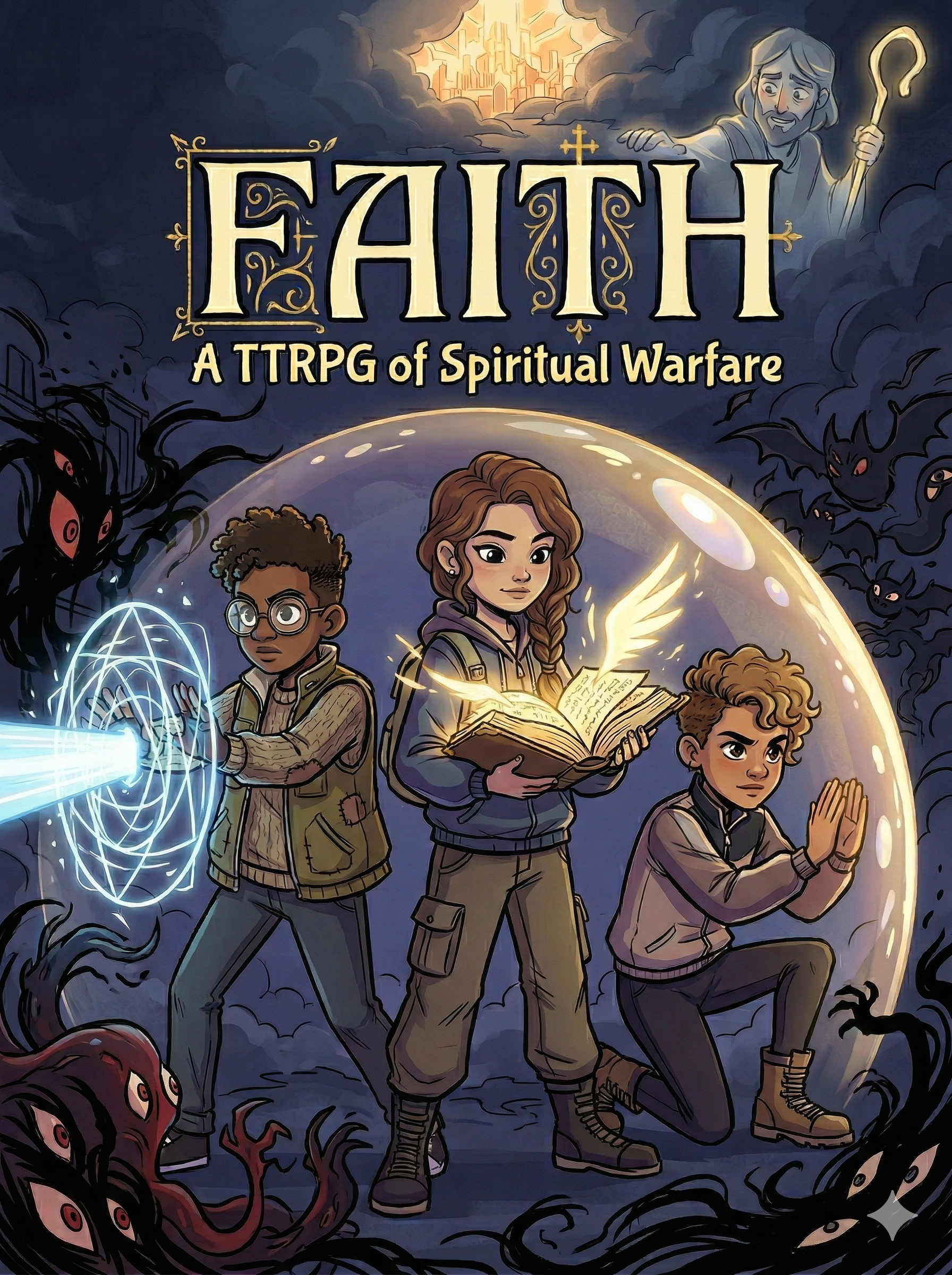
Cover art for the Faith Core Rulebook by Rutz Studios, available on DevLoot.
One example on our own shelf: Faith, a Christian tabletop RPG from Rutz Studios, builds its resolution around a Faith Die that sits on a ladder and shifts with what your character does. The tagline is playing by faith and not by sight, and the mechanic carries that theme rather than sitting next to it. Characters are defined by Fruits, they face Trials, and the Armor of God shows up on the sheet as actual moving parts. It is a genre game with a clear audience, and if that audience is you or your group, it is worth a look. If it is not your table, the design lesson still travels: pick the mechanic that argues for the thing your game is about. The Core Rulebook runs 19.99 dollars, with a 2-page character sheet and a GM guide called The Shepherd's Companion sold separately. We covered the wider category in our roundup of faith-based tabletop RPGs.
Picking the one your table actually wants
Skip the debate and answer three questions honestly.
- Should a novice ever beat an expert? If yes, go flat, d20 or d100. If rarely, use a bell curve or a pool.
- Do you want failure to stop the scene or complicate it? If complicate, you want partial success in the core loop, not bolted on as an afterthought.
- How much arithmetic can your group tolerate at 10pm on a weeknight? Adding 3d6 plus modifiers is slower than reading one die. This matters more than anyone admits.
Then playtest for two sessions before you commit. Probability tables are useful, but the only test that counts is whether your players lean forward when the dice hit the table.
Next step
Take your campaign's next big scene and ask what the dice are promising. If that does not match the story you are trying to tell, change the mechanic, not the players. Then browse the tabletop RPG shelf on DevLoot and see what other designers decided, and why.