NPC Emotions in Unity: Why Your Characters Feel Flat and How to Fix It
There is a moment in every project where you walk your own build and realize the world is technically fine and emotionally dead. The lighting is good. The animations blend. The quest log updates. And yet every character in the scene has the same face no matter what you do to them. You can rob a shopkeeper, save their village, or stand in their kitchen for nine minutes doing nothing, and the greeting line comes out identical every single time.
That flatness is not an art problem. It is a state problem. Most Unity projects model characters as inventories and health bars, which are numbers the player changes directly, and then stop. Nobody models the thing that actually makes a character feel alive: an internal state that drifts on its own, reacts to what happened, and colors everything the character does afterward.
Why "reactive NPCs" usually collapse into a pile of booleans
Almost everyone tries to solve this the same way. You add isAngry. Then you add isScared, because anger and fear are not the same. Then you need angerTimer so the NPC calms down eventually. Then a designer asks whether a brave guard should get scared as easily as a shopkeeper, so now you have per-character multipliers scattered across three prefabs.
Six weeks later you have forty booleans, a coroutine nobody wants to touch, and no way to answer the simplest question a designer will ask: what is this character feeling right now, and why? Worse, none of it survives a scene load, so the guard you terrified in the market is fresh and cheerful when the player walks back in.
Players do not notice systems. They notice that the guard who watched them burn down the granary still sounds nervous an hour later.
The failure is architectural. Emotion is not a set of flags. It is a set of continuous values that push against each other, drift back toward a personal baseline over time, and get filtered through whatever kind of person the character is. Booleans cannot express any of that, which is why boolean-based mood systems always feel like a light switch instead of a person.
What an actual emotion layer needs to do
If you sat down to build this properly, the requirements list is longer than it first looks:
- Custom emotions per project, because a horror game and a farming sim need different vocabularies
- Values that move gradually rather than snapping between states
- Cross-influence, so rising fear can suppress joy without you hand-writing every pair
- Decay back toward a baseline, with a cooldown so a single event does not instantly evaporate
- Personality bias, so the same event lands differently on a timid character than a reckless one
- A dominant-emotion signal your dialogue, animation, and AI code can actually read
- Save and load, because emotional state that resets on scene change is worse than none at all
- Some way to see it while you play, or you will never balance it
That last one is the killer. Tuning invisible floating point values by guessing and rebuilding is how a two day feature turns into a two month feature. Without live inspection you are debugging a mood by print statement.
The shortcut: a purpose-built emotion system
This is exactly the gap that the Emotions dynamic emotion system for Unity fills. It is a standalone Unity 6 LTS package that gives characters an emotional state layer with all of the above already solved, so you spend your time deciding what your characters feel instead of building the plumbing that lets them feel anything.
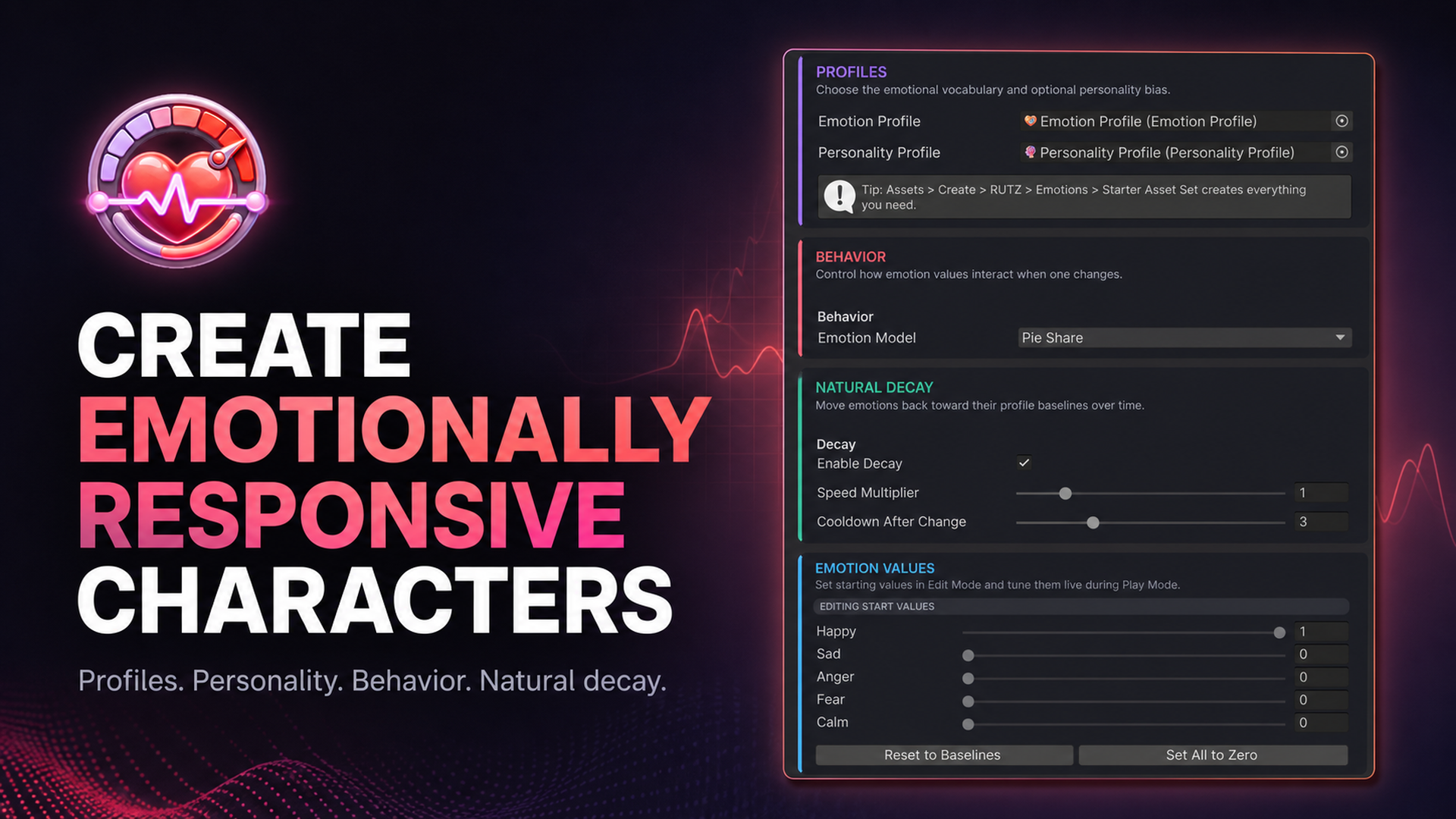
You define an Emotion Profile: the emotions your game cares about, their baselines, and how fast each one settles. A survival horror project might run Fear, Panic, Resolve and Exhaustion. A cozy life sim might run Happy, Lonely, Content and Irritated. You are not stuck with someone else's five feelings.
Behavior settings then control how those values interact when one changes, and the natural decay section handles the drift back toward baseline with an adjustable speed multiplier and a cooldown after each change. That cooldown matters more than it sounds. It is the difference between an NPC who stays rattled for a while and an NPC who forgets the explosion in half a second.
Personality is what stops every character sounding the same
The part that does the most work for the least effort is the Personality Profile. You define traits with weights, things like Brave, Shy, or Empathetic, and those traits bias how the character processes incoming emotional events.
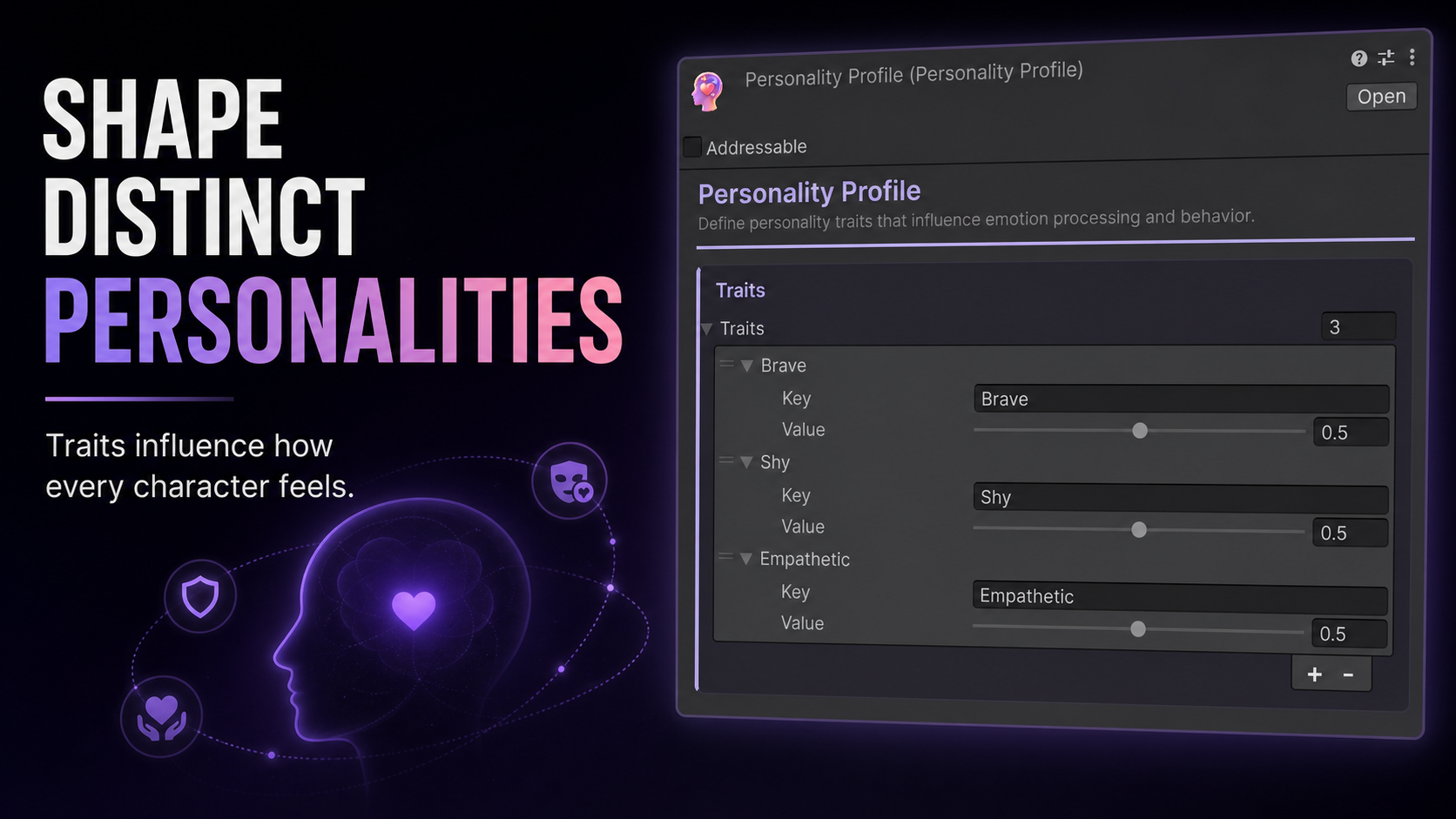
One scripted event, fired at ten NPCs with different personality assets, produces ten different reactions. That is an enormous content multiplier for a five minute setup, and it is the practical answer to the problem of a village where everyone reacts to the dragon with the same shrug. If you have read our piece on giving NPCs daily schedules, this is the natural companion layer: schedules decide where a character is, emotion decides how they behave when the player gets there.
Tuning it without losing a week
Emotion values are editable live in Play Mode. You set your start values in Edit Mode, hit play, and then drag sliders while the game runs to see how decay, cooldown and cross-influence actually behave. Balancing stops being a rebuild loop and becomes a conversation with the running game.
There is also a UI generator that builds and wires a full emotional state HUD in one step: dominant emotion readout, radial emotion spheres, horizontal fill bars, and interactive emote buttons for testing. It finds the components in your scene and connects them for you.
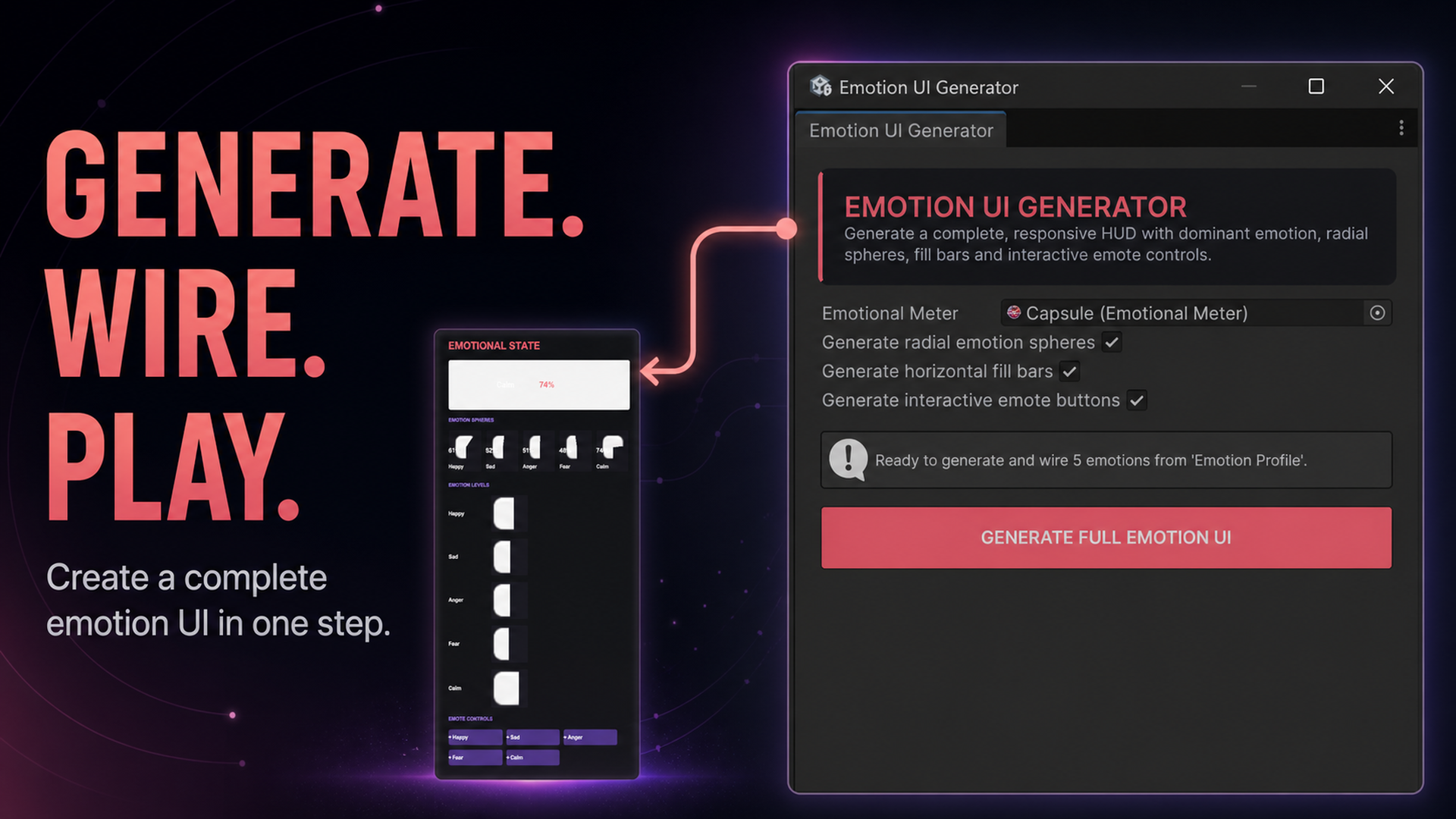
Even if you never ship that HUD to players, having it during development is worth the install on its own. Being able to watch the numbers move is the thing that turns a vague mood system into something you can actually design against.
Wiring it into the rest of your game
The system exposes a public runtime scripting API plus UnityEvent hooks and a dominant-emotion-changed callback, so it plugs into whatever you already have. A few things it slots into cleanly:
- Dialogue: branch on dominant emotion instead of writing a separate flag for every mood. This pairs particularly well with local AI driven NPC dialogue, where the current emotional state becomes context for what the character says.
- Animation and audio: drive a blend tree parameter or swap a voice bank when the dominant emotion changes.
- AI behavior: a frightened guard flees, a furious one charges, using the same behavior tree with different weights.
- Relationships and companions: long running affinity that shifts based on what the player actually does.
State saves through PlayerPrefs or JSON with multiple save slot support and optional automatic save and load, so the emotional history of your world survives a quit and reload. That persistence is what turns a neat toy into a mechanic players remember.
Who this is actually for
If you are making an RPG, a narrative game, a life sim, a companion-driven adventure, a horror game, or anything with recurring NPCs, this solves a problem you will hit eventually and will not enjoy solving twice. If you are making a wave shooter where enemies exist for four seconds, skip it. Emotional continuity only pays off when characters persist long enough for players to notice the continuity.
The honest pitch is time. You could build this. It is not exotic computer science. But you would spend weeks on decay curves, save serialization, custom inspectors and debug UI before writing a single line of gameplay that uses any of it. Buying the layer means you start at the interesting part.
Try it on one character first
Do not retrofit your whole cast. Pick the single NPC the player talks to most, give them three emotions and one personality profile, and hook the dominant emotion into two or three dialogue lines. Play for ten minutes. If that one character suddenly feels like a person, roll it outward.
Grab Emotions, the dynamic emotion system for Unity 6, on DevLoot and give your characters something to feel.