
Best Beginner Friendly TTRPG Systems: How to Pick Your First Game
You want to start playing tabletop RPGs, you open a search bar, and you are hit with a wall of names. Dungeons & Dragons, Pathfinder, Blades in the Dark, Fate, Cairn, Mouse Guard. Which one is actually right for a first game? The honest answer is that the "best" beginner system depends on three things: who is at the table, how much reading you will tolerate, and what kind of story you want to tell. Let's sort that out.
What makes a system beginner friendly?
Skip the popularity contest and ask four plain questions instead.
- How long until the first roll? A good starter game lets a new player make a character in ten to twenty minutes, not an evening.
- How many rules must the GM memorize? You can always look things up, but a system that needs constant lookups drags a first session down.
- Does it have a free or cheap way in? A quickstart PDF or starter set means you can test the waters before buying a shelf of books.
- Does it support the story you want? A heist crew, a dungeon crawl, and a quiet campaign about faith and doubt need different tools.
Keep those in mind. They matter more than any ranking list, including this one.
The big names: D&D and Pathfinder
Dungeons & Dragons Fifth Edition is the default for a reason. There is a huge amount of free learning material, a starter set aimed squarely at newcomers, and a good chance someone you know already owns a set of dice. Wizards of the Coast also publishes free basic rules online, so you can read before you spend. The tradeoff is that the full game has plenty of moving parts, and a first-time GM can feel buried by spell lists and edge cases.
Pathfinder Second Edition is the crunchier cousin. Its Beginner Box is a real on-ramp, with a player handbook, a GM guide, and a solo adventure to learn the basics. If your group loves tactical choices and building a character with lots of options, it is a great pick. If you want to start playing in twenty minutes, it may be more than you need on night one.
The best first system is the one your group will actually finish a session with.
Lighter options worth a look
Plenty of newer players do better with fewer rules and more conversation. A few well-regarded picks:
- Fate Accelerated. A flexible, story-first system that works for almost any setting. You describe your character with short phrases instead of long stat blocks.
- Blades in the Dark. A Victorian-flavored crew-and-heist game. Free basic rules and character sheets make it easy to try, though it asks the GM to embrace improvisation.
- Mouse Guard. Small mice defending their homeland in a medieval world, played mostly with six-sided dice. Charming, and it gives players real narrative responsibility.
- Fiasco. No GM at all. You build a crime-caper story together in a single sitting. Great for a one-off night with friends who have never touched a rulebook.
- Old-school-inspired games like Cairn. Rules that fit on a few pages, with the focus on exploration and clever play rather than a long list of abilities.
I would not call any of these "easy" in every respect. Narrative games shift the work from learning rules to improvising, which some people find freeing and others find scary. If you have read our guide on prepping less and improvising more, you already know a lot of that skill is learnable.
Match the system to the table
Here is a quick way to decide.
- A group of friends who love video game RPGs: D&D 5E or Pathfinder 2E. The tactical combat will feel familiar.
- A group that likes acting and storytelling more than math: Fate Accelerated or Mouse Guard.
- A single evening with no prep: Fiasco or a one-page game.
- A family with kids: a light system with simple dice, as we covered in tabletop RPGs for kids and family.
- A group that wants faith and meaning woven into play: a game built for that on purpose, which brings us to the next section.
A game built around faith: Faith by Rutz Studios
Most mainstream games treat religion as flavor text or a cleric class. Some people want something different: a game where belief, trust, and moral weight are part of how the rules work. That is the niche a Christian tabletop RPG fills, and it is a real one, as we explored in our look at faith-based tabletop RPGs.
DevLoot carries one such game, Faith: Core Rulebook from Rutz Studios. It is described as a complete original Christian tabletop RPG where you play by faith, not by sight. The line also includes a two page character sheet with a Faith Die ladder, Fruits, and a prayer journal, plus The Shepherd's Companion, a guide for the GM (called the Shepherd) covering Trials and building sacred worlds.
Who is it for? Church youth groups, families, and players who want a game whose themes match their own convictions. Who is it not for? Anyone who wants a generic dungeon crawl. That is fine. A focused game is better than a vague one, and you do not need to share the faith to appreciate how deliberately the mechanics were built around its themes.
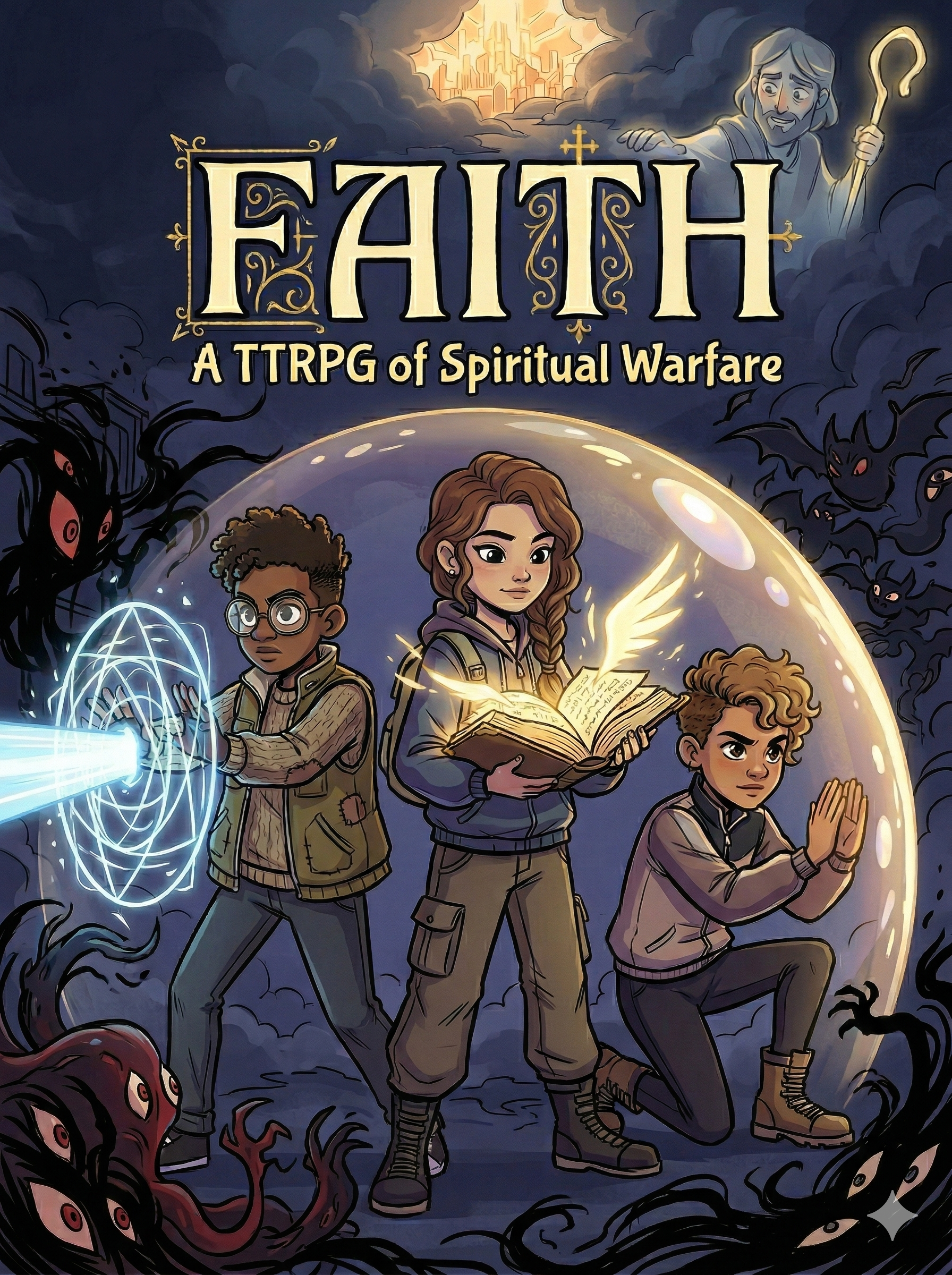
Faith: Core Rulebook by Rutz Studios. See it on DevLoot.
If you are curious but unsure about the format, remember that digital copies are a low-risk way to read before committing, which we weigh up in PDF vs print RPG books.
Your first session, step by step
- Pick one system and commit to it for three sessions. Switching after one rough evening teaches you nothing.
- Read the quickstart, not the whole book. Almost every system has a short version for exactly this reason.
- Hold a session zero. Agree on tone and limits before the dice come out. Our guide to session zero and safety tools walks through it.
- Run a short adventure. A single location, a clear goal, and one interesting problem is plenty.
- Ask for feedback. What was fun? What dragged? Adjust and play again.
If you need a full walkthrough of that first night, start with how to run your first TTRPG session as a GM.
The short version
There is no single best beginner system, only a best fit for your table. Pick D&D or Pathfinder if you want the biggest community and the most tactical play. Pick a lighter story game if you would rather talk than calculate. Pick a themed game like Faith if the setting and values are what will keep your group coming back. Then play, because a mediocre session you actually ran beats a perfect one you kept planning.
Ready to browse? Have a look at the Faith Core Rulebook or the wider tabletop collection on DevLoot, grab the character sheet, and set a date with your friends.
Hero photo: "Black Polyhedral Game Dice" by Dark Elf Dice, Wikimedia Commons, CC BY-SA 4.0.
